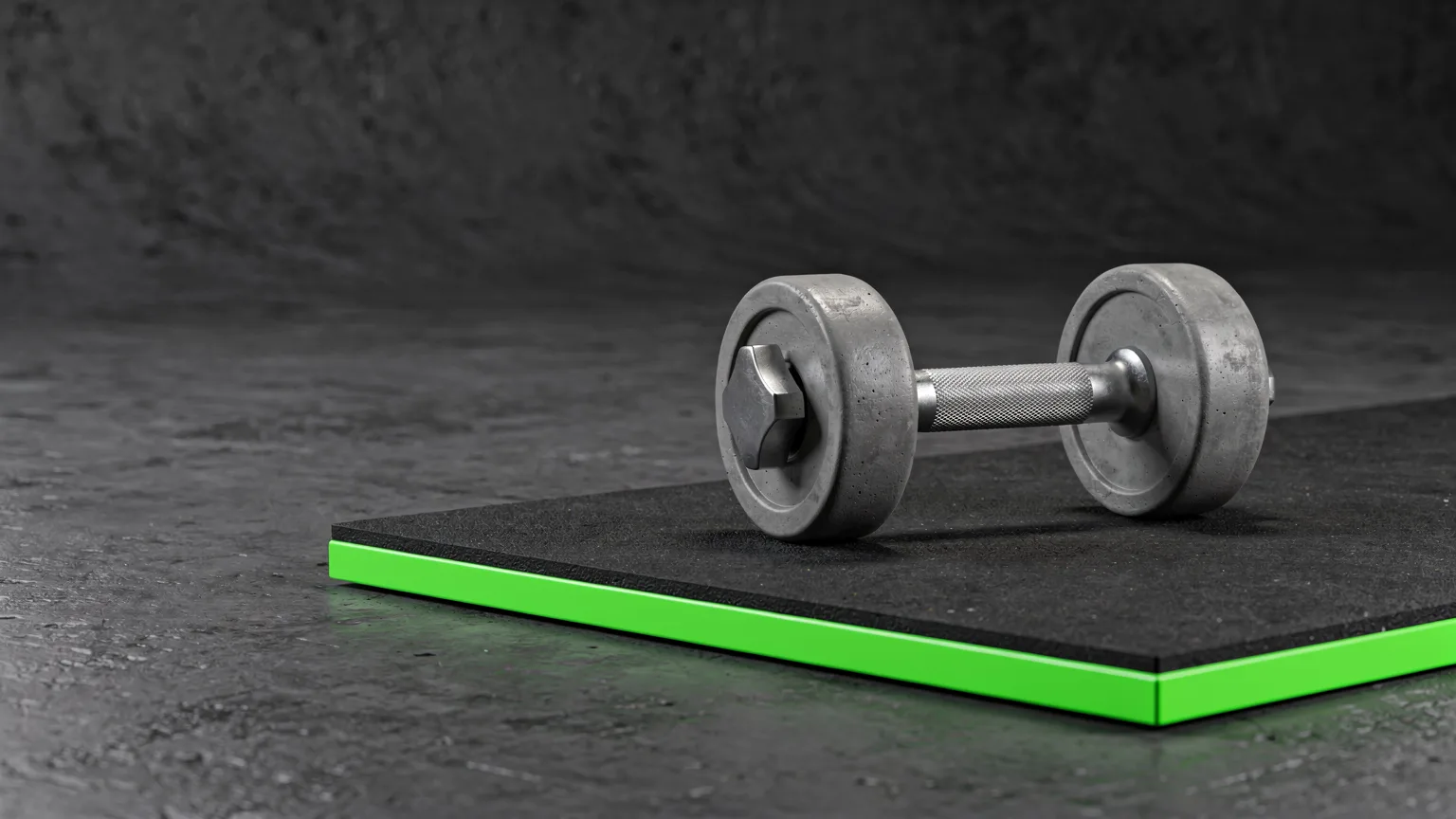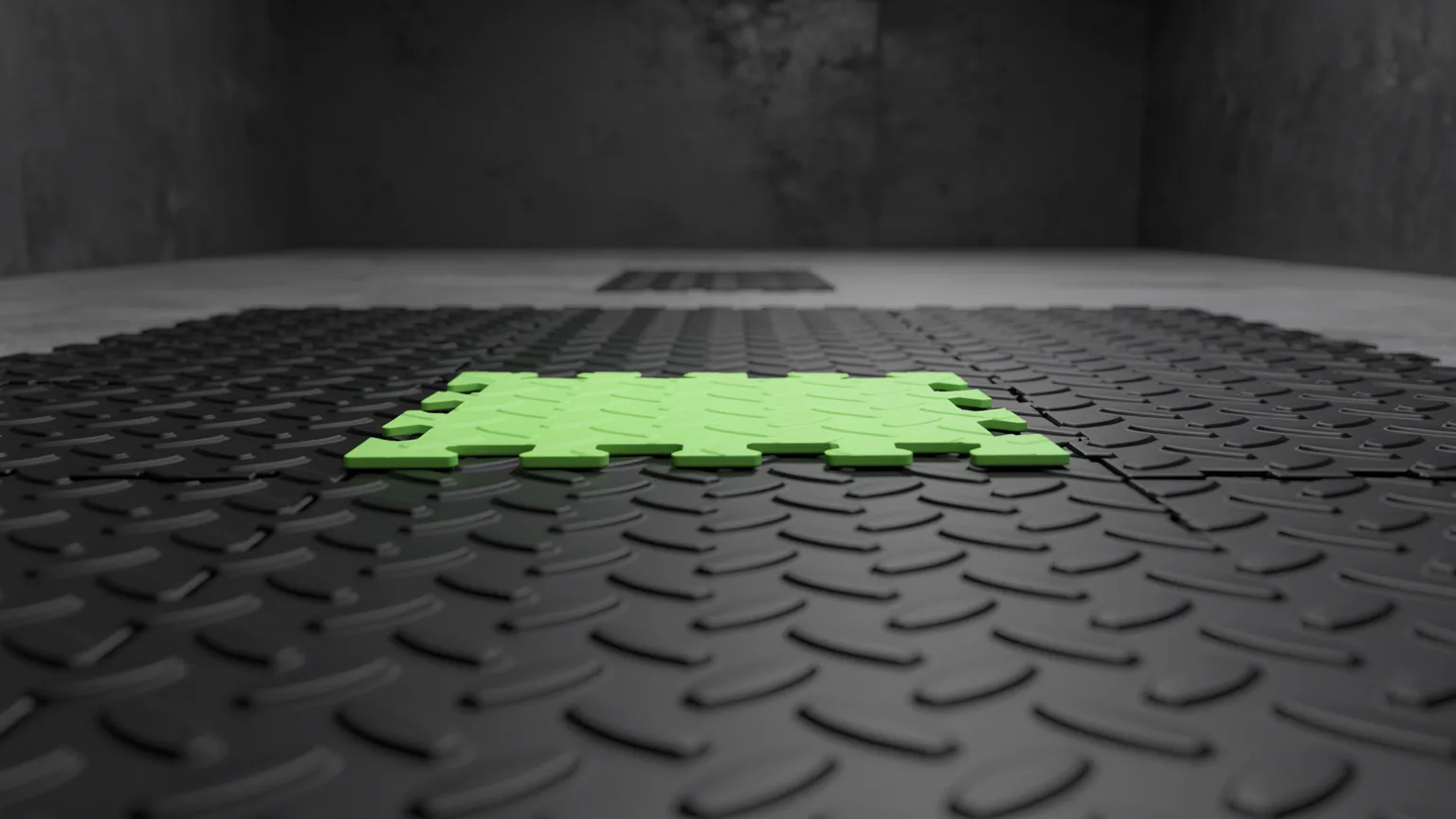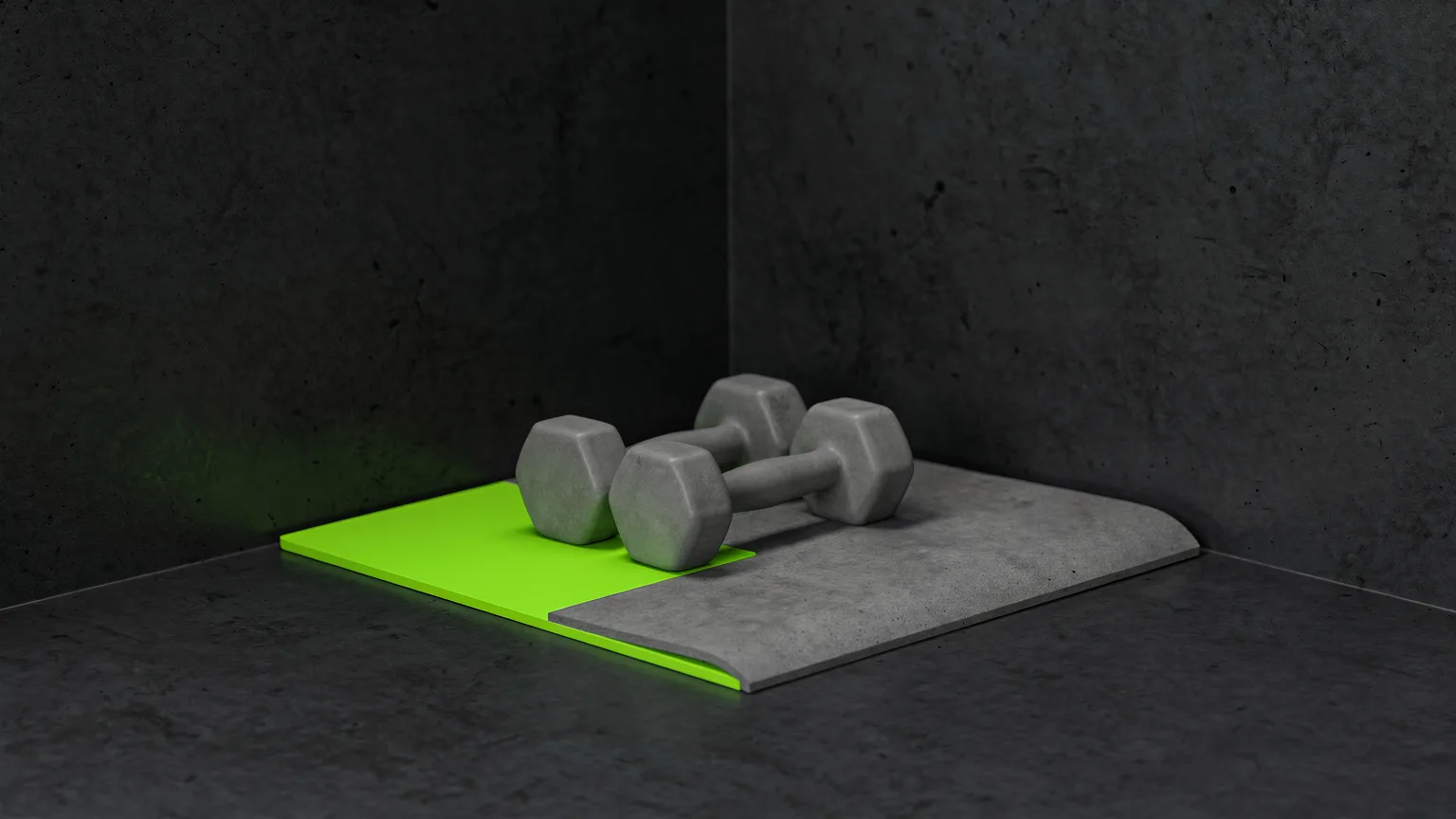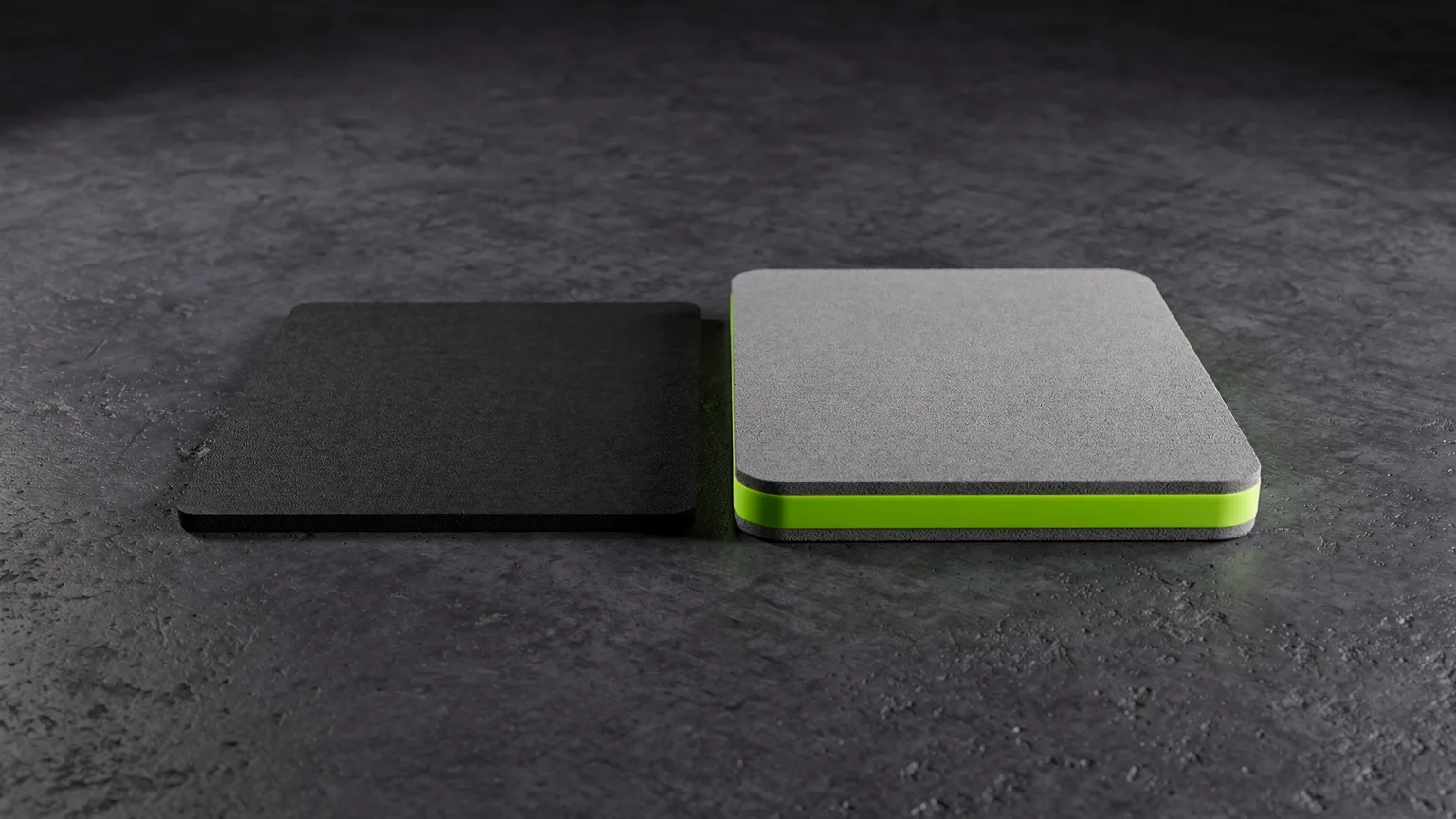
In the rubber flooring vs foam mats choice, solid rubber suits any area where weights are set down or dropped, and foam or rubber-topped foam tiles suit bodyweight work, stretching, cardio kit and small spaces. Foam makers publish no load rating, while ARKMat states its rubber absorbs free-weight impact.
Do I need rubber flooring for a home gym with just dumbbells?
Light dumbbell work suits foam on the makers' own descriptions, but heavier dumbbells that will be set down firmly are better matched by solid rubber, which ARKMat states absorbs free-weight impact. No foam tile maker reviewed publishes a load rating, so the choice rests on the maker's stated use. The rest of this guide sets out what each material is and what the makers say.
What each material is
Solid rubber
Solid rubber comes as mats, tiles or rolls. ARKMat sells 12mm and 17mm mats, 6ft x 4ft (1.82 x 1.22m, about 2.22 square metres), describing them as non-porous, non-absorbent natural rubber that will not swell, curl or lift, and saying they absorb the impact of free weights, home gyms, treadmills and kids' rooms (ARKMat). A commercial roll such as Regupol's everroll classic is SBR granulate bonded with PUR and 20% EPDM, weighs about 1.06kg per square metre per millimetre, and is offered from 4mm to 12mm (Regupol). Rubber is heavy: a 12mm roll is roughly 12.7kg per square metre (calculation from the maker figure). Regupol also makes the same material as 600 x 600mm tiles at 6mm.
Foam and rubber-topped foam
Foam tiles interlock and are light. York Fitness sells foam tiles 60cm x 60cm and 1.3cm thick, four to a pack with edging, for floor exercises and for use under its equipment (York Fitness). Nicoman sells a hybrid: high-density EVA foam and recycled rubber with a rubber top, 62cm x 62cm and 14mm thick, free from phthalates, lead and latex, with two detachable edge pieces per mat (Nicoman). The AIRHOP ACTIVE pack in our data is the same rubber-top-over-EVA format, but no maker page could be found to confirm its specification.
Side by side
| Point | Solid rubber | Foam / rubber-top foam |
|---|---|---|
| Maker statement on weights | ARKMat: absorbs impact of free weights; Regupol lists weightlifting as an application | York: floor exercises and under York equipment; Nicoman: says it holds heavy machinery, no rating |
| Typical thickness | ARKMat 12mm or 17mm; Regupol 4 to 12mm | York 1.3cm; Nicoman 14mm |
| Weight | About 1.06kg per m2 per mm for a Regupol roll; ARKMat does not publish mat weight | Neither York nor Nicoman states a weight on its page |
| Handling | Heavy mats or rolls; ARKMat 12mm has an underside handle | Interlocking tiles with edge pieces |
| Noise statement | ARKMat: greatly reduced noise levels; Regupol: 19dB impact-sound reduction for 8mm roll in a laboratory measurement | York says the tiles muffle noise; Nicoman says they reduce noise and impact; no decibel figure |
| Warranty stated | Not stated on the ARKMat page | York: 12 months, manufacturing faults only, indoor household use; Nicoman: not stated |
Are rubber-topped foam tiles the same as solid rubber?
No: Nicoman's tile is a high-density EVA foam base with a rubber top, 14mm overall, which is a different construction from a solid 12mm or 17mm rubber mat. Reasoning from the materials, foam gives under a concentrated load and rubber resists it, which is why solid rubber is the more defensible option beneath dumbbells and a rack. Rubber-topped tiles put a harder layer on a foam core, but with no load rating published it is unclear how far that goes. For the heavier case see our heavy-weights flooring guide.
Thickness figures sit close together across the two groups: York's foam is 1.3cm, Nicoman's rubber-top tile 14mm, and ARKMat's solid rubber 12mm or 17mm. The numbers are similar, but the materials are not, which is why thickness alone is a poor guide.
Can foam mats reduce noise from a home gym?
They soften footfall and small impacts, but they are not a complete fix for rooms below. York says its tiles muffle noise and Nicoman says its mats reduce noise and impact, though neither publishes a decibel figure. Regupol quotes 19dB impact-sound reduction for an 8mm roll in a laboratory measurement and describes sound insulation in fitness spaces as a layered system with spring and damping properties, designed around the building (Regupol acoustics). A single mat on an upstairs floor should be expected to help, not to solve the problem. See our noise guide.
Is rubber flooring worth it over foam mats in a rented flat?
It depends on the kit: foam suits a temporary setup, while solid rubber is heavier but better documented for weights. Foam tiles are light and have edge pieces, and Nicoman describes its pieces as easy to connect, disassemble and move. Check your tenancy terms, and see our renters guide for lease and deposit points and small apartment gym setup for compact layouts. A rubber mat adds weight to a timber upper floor, so in a flat it is worth asking the landlord or a structural professional about a rack and plates.
Layout, edges and joins
A 6ft x 4ft mat covers about 2.22 square metres in one piece, so a small gym needs only a few joins, while tiles need many interlocks and edge pieces. Joins are where tiles can lift or shift, so check how the maker's edging works before covering a large area. York's pack of four tiles measures 122cm x 122cm with the edging in place, and York says to buy multiple packs for larger areas. Nicoman sells packs of 4 up to 144 tiles, so a whole room is a matter of ordering the right pack count. Regupol and ARKMat publish no interlock design for their products on the pages opened.
Cost and coverage
In the data, the Nicoman 9-pack is around £60 (checked Oct 2026), which by simple division is about £17.34 per square metre across roughly 3.46 square metres before edge pieces. The AIRHOP ACTIVE 12-pack is around £129.99 (checked Oct 2026), but its tile size is unpublished, so no coverage figure is possible. The ARKMat 12mm listing is around £53.95 (checked Oct 2026) for one 6ft x 4ft mat, about £24.30 per square metre by the same division. These are not like-for-like products, since thickness and material differ, and they are not maker figures.
Subfloor
Both materials sit on the existing floor, and the base still matters. Installation guidance for commercial glue-down gym rolls asks for a dry, clean, smooth and structurally sound surface, flat to 4.8mm over 3m, and says particleboard and chipboard are unsuitable underlayments for its flooring (Acoustical Solutions). That guide is for a US, glued product, so it indicates good practice rather than a rule for loose mats. Rubber is the heavier option, so on a timber upper floor ask a structural professional before adding a rack and plates on top of it.
Which to choose
- Dumbbells, kettlebells, a rack: solid rubber.
- Yoga, bodyweight, a bike or rower: foam or rubber-top tiles are enough on the makers' descriptions.
- Small flat or temporary setup: tiles.
- Not sure: put solid rubber under the heavy kit and tile the rest.
The full range of materials, thicknesses and subfloors is in our main flooring guide.
What to check
- Thickness and area per pack on the maker's page.
- Any limit on intended use, such as York's indoor household warranty.
- Whether edge pieces are included; Nicoman lists two detachable edge pieces per mat and York includes edging in the pack.
- Moulding marks: ARKMat says rubber mats may show marks and flash along edges, which can be trimmed and are not a manufacturing defect.
- Returns: York's 14-day promise excludes items removed from the box or installed.
Who should skip this
If you will drop loaded barbells, neither a foam tile nor a basic mat is an engineered solution. Ask a flooring specialist and follow the equipment manuals.