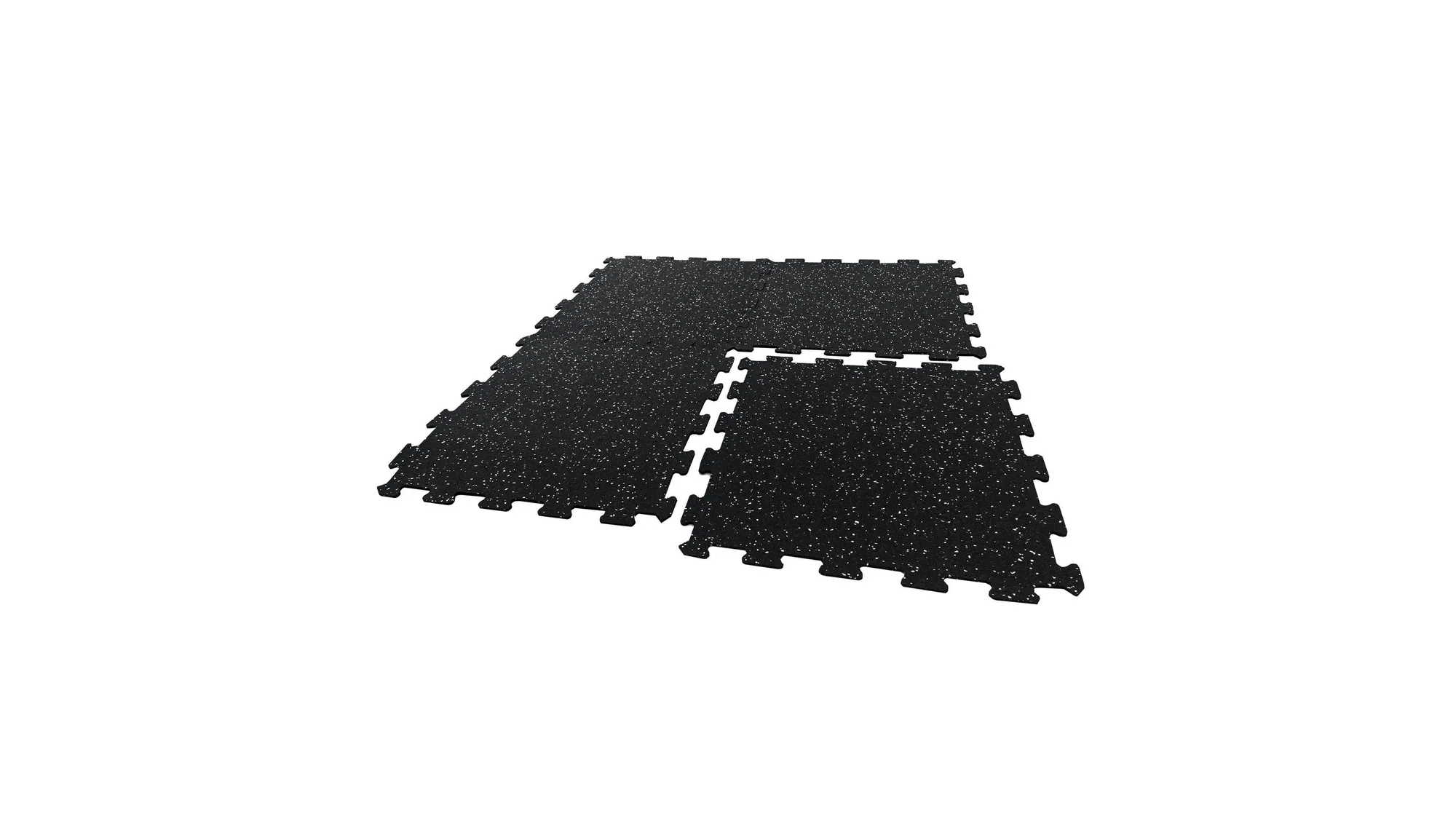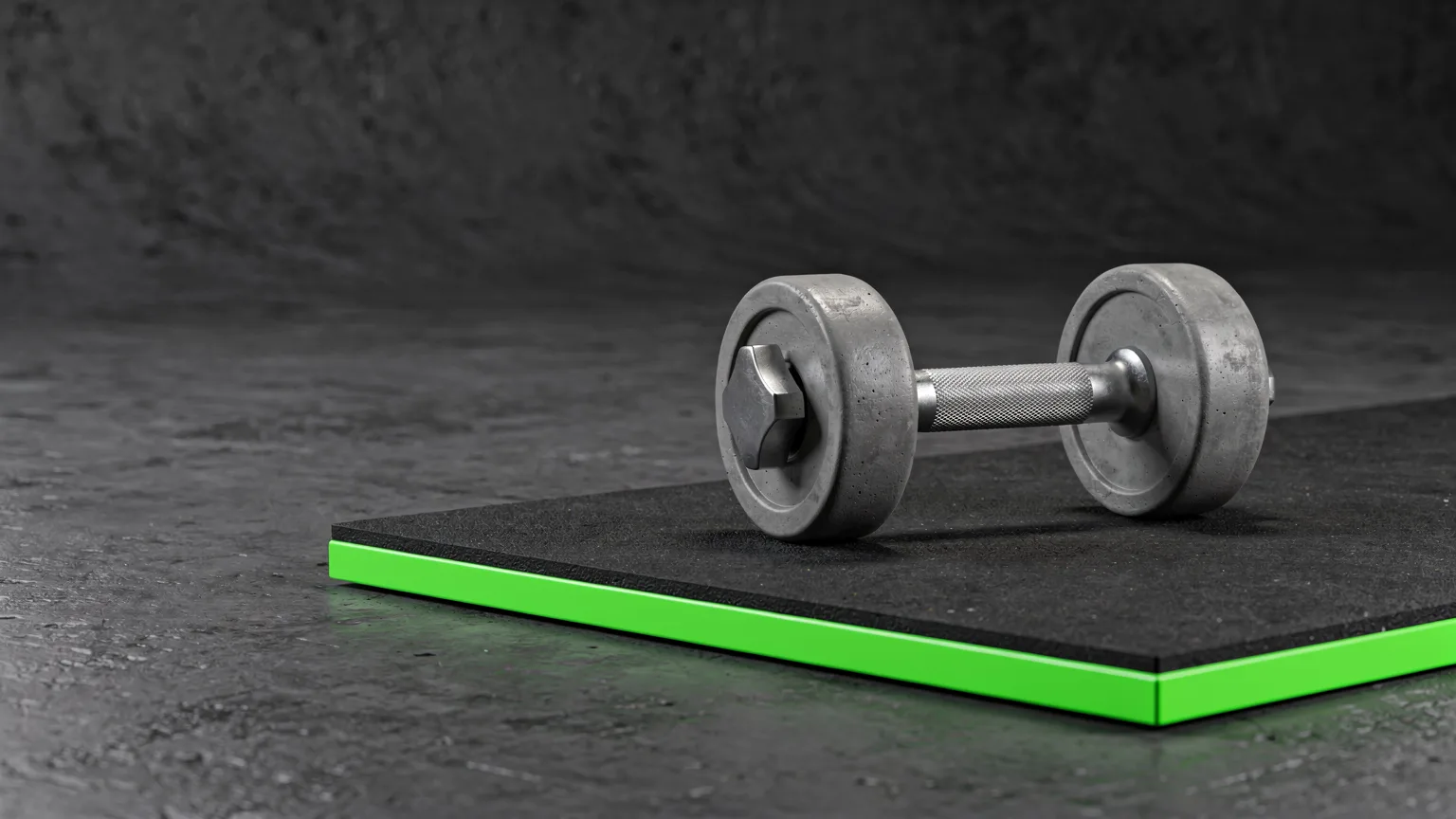
The best home gym flooring for heavy weights is solid rubber of at least 12mm, such as a 12mm or 17mm rubber mat or a rubber roll, rather than foam tiles. No maker publishes a drop-height or load rating for consumer flooring, so this guide compares published specifications and says where the evidence stops.
Are foam tiles enough for heavy weights?
No foam tile maker reviewed publishes a load rating, so solid rubber is the better-documented option for heavy weights. The reasoning is about material rather than thickness: foam compresses under a point load, and a thicker foam compresses more, while solid rubber resists indentation better. That is reasoning from the materials, not a measured result.
It is also why foam makers describe their tiles for lighter use. York Fitness markets its 1.3cm foam tiles for floor exercises and for use under York equipment, and says nothing about a load or drop capacity (York Fitness). Nicoman's 14mm rubber-topped EVA tile, made from high-density EVA foam and recycled rubber, states no load rating either, although the page says the mats can hold the weight of heavy machinery without giving a figure (Nicoman). A claim without a number cannot be compared with anything, so treat it as marketing until the maker supplies one.
The options for heavy weights
Solid rubber gym mats
ARKMat sells 12mm and 17mm mats, each 6ft x 4ft (1.82 x 1.22m, about 2.22 square metres). The maker describes solid, non-porous, non-absorbent natural rubber that will not swell, curl or lift, and says it absorbs the impact of free weights, home gyms and treadmills. The 12mm version has an integrated underside handle; the 17mm has grooves on the reverse and no handles (ARKMat). The maker also notes possible moulding marks and flash along edges that can be trimmed, and says new mats may carry mould-release residue that household detergent removes. The weight is not published. The 12mm mat is listed at around £53.95 (checked Oct 2026).
Rubber rolls
Commercial rolls show what a heavier-duty roll looks like on paper. Regupol's everroll classic is PUR-bonded SBR granulate with 20% EPDM, offered in 4, 6, 8, 10 and 12mm and rolls 1,250mm wide, at about 1.06kg per square metre per millimetre. It lists free weight training and weightlifting as applications, force reduction of up to 16% under EN 14904, and impact resistance above 21 Nm following EN 14904 / EN 1517 (Regupol). A 12mm roll is roughly 12.7kg per square metre, and a 10m roll at 12mm is roughly 159kg (calculations from the maker figure), which shows how heavy a rubber floor is to handle. The page does not say whether the roll is loose-laid or glued, so ask the maker. The linked GCM roll has no maker page, so its thickness and rubber type could not be verified; it appears at around £233.99 (checked Oct 2026).
Rubber-topped tiles
The AIRHOP ACTIVE rubber-topped tile pack appears at around £129.99 (checked Oct 2026). No maker page could be found, so its thickness, tile size and coverage are unverified here.
Are horse stall mats suitable for a home gym?
They are a common substitute, but the maker sells them for horses and livestock and makes no gym statement, so using them in a gym is the buyer's decision. First Mats lists a 120 x 180cm rubber stable mat in 12mm (22.7kg) and 17mm (36.25kg), with built-in drainage channels, a textured slip-resistant surface, a loose-lay design and a trim-to-fit option (First Mats).
Per square metre, the maker weights work out at roughly 10.5kg for 12mm and 16.8kg for 17mm (calculation), which helps when judging how heavy an area will be to carry and how much it adds to a timber floor. The page quotes a lead time of 2 to 3 working days and says anything cut to your own specification cannot be returned unless faulty, so measure before trimming. The drainage channels mean a textured surface rather than a flat one, which matters under rack feet and bench legs.
How the options compare
| Option | Material | Maker-published details |
|---|---|---|
| ARKMat gym mat | Solid natural rubber | 12mm or 17mm, 6ft x 4ft, weight not published, says it absorbs free-weight impact |
| First Mats stable mat | Rubber | 12mm 22.7kg, 17mm 36.25kg, 120 x 180cm, drainage channels, no gym statement |
| Regupol everroll classic | SBR/EPDM rubber roll | 4 to 12mm, about 1.06kg per m2 per mm, weightlifting listed as an application, impact resistance above 21 Nm |
| Nicoman tile | Rubber top, EVA base | 62cm, 14mm, no load rating, weight not published |
| York Floor Guards | Foam | 60cm, 1.3cm, no load rating |
Which suits which situation
- Heavy dumbbells set down on a sound floor: a 12mm solid rubber mat is the minimum documented option; the 17mm version is the thicker choice from the same maker.
- A rack and bench area: solid rubber is firmer underfoot than foam tiles, which matters for stability. Check the rack's manual for floor and footprint guidance, and see our power rack guide and rack selection guide.
- A whole garage: a roll gives continuous coverage; mats leave seams.
- Light kit only: foam is adequate on the maker's own description, and our rubber versus foam guide covers the trade-off.
Will heavy dumbbells damage a concrete garage floor without matting?
The makers reviewed publish no figure for this, so it cannot be quantified from their pages. A rubber layer still protects the floor and the weights, and the surface should be clean and dry before laying it. Installation guidance for commercial glue-down gym rolls asks for a dry, clean, smooth and structurally sound base, flat to 4.8mm over 3m, with moisture measured on concrete (Acoustical Solutions). That guide is for a US glued product, so it indicates good practice rather than a rule for loose mats.
Do you need double-layered flooring for very heavy lifts?
The consumer makers reviewed publish no guidance on layering, so the question cannot be answered from their pages. A dedicated lifting platform is an engineered build-up, not a mat laid over a mat, so ask the platform or flooring maker and a qualified professional. Stacking two mats also changes the height of any rack feet or bench legs and how they sit, which the rack manual does not necessarily cover.
Barbells and dropping weights
No maker opened for this guide publishes a rating for dropped barbells on its consumer flooring. A mat reduces impact on the floor and the plate, but it does not make dropping a loaded bar from height a safe habit. Follow the equipment manuals, and read our home gym safety page. For a lifting platform, ask the maker and a qualified professional, because a platform is an engineered build-up, not a mat.
Is rubber flooring enough to stop noise reaching rooms below?
It reduces impact noise but is unlikely to remove it. Regupol describes fitness sound insulation as a flooring system of different layers with spring and damping properties, tailored to the building structure (Regupol acoustics), so a single mat should be expected to reduce, not remove, noise to rooms below. Regupol also lists impact-sound reduction of 19dB for an 8mm roll in a laboratory measurement, which is a commercial roll, not a mat on a joisted floor.
On timber, rubber and kit add to the load, so ask a structural engineer about your joists before building a heavy setup upstairs. Rigid, non-moving timber is what the Acoustical Solutions guide asks for under its glued flooring. See the noise guide and our main flooring guide.
What to check
- Thickness, mat size and weight on the maker's page; ARKMat does not publish the weight.
- Whether the maker states the product is for gym use. First Mats does not.
- How seams or interlocks sit under a rack's feet.
- Delivery area and returns: York's page excludes remote Scotland, and First Mats does not accept returns of cut-to-size mats unless faulty.
- Warranty, which York limits to 12 months for manufacturing faults.
Who should skip this
Anyone training in an upstairs flat, or planning regular drops, needs specialist acoustic and structural advice more than a mat. Anyone with only light kit does not need heavy rubber at all.