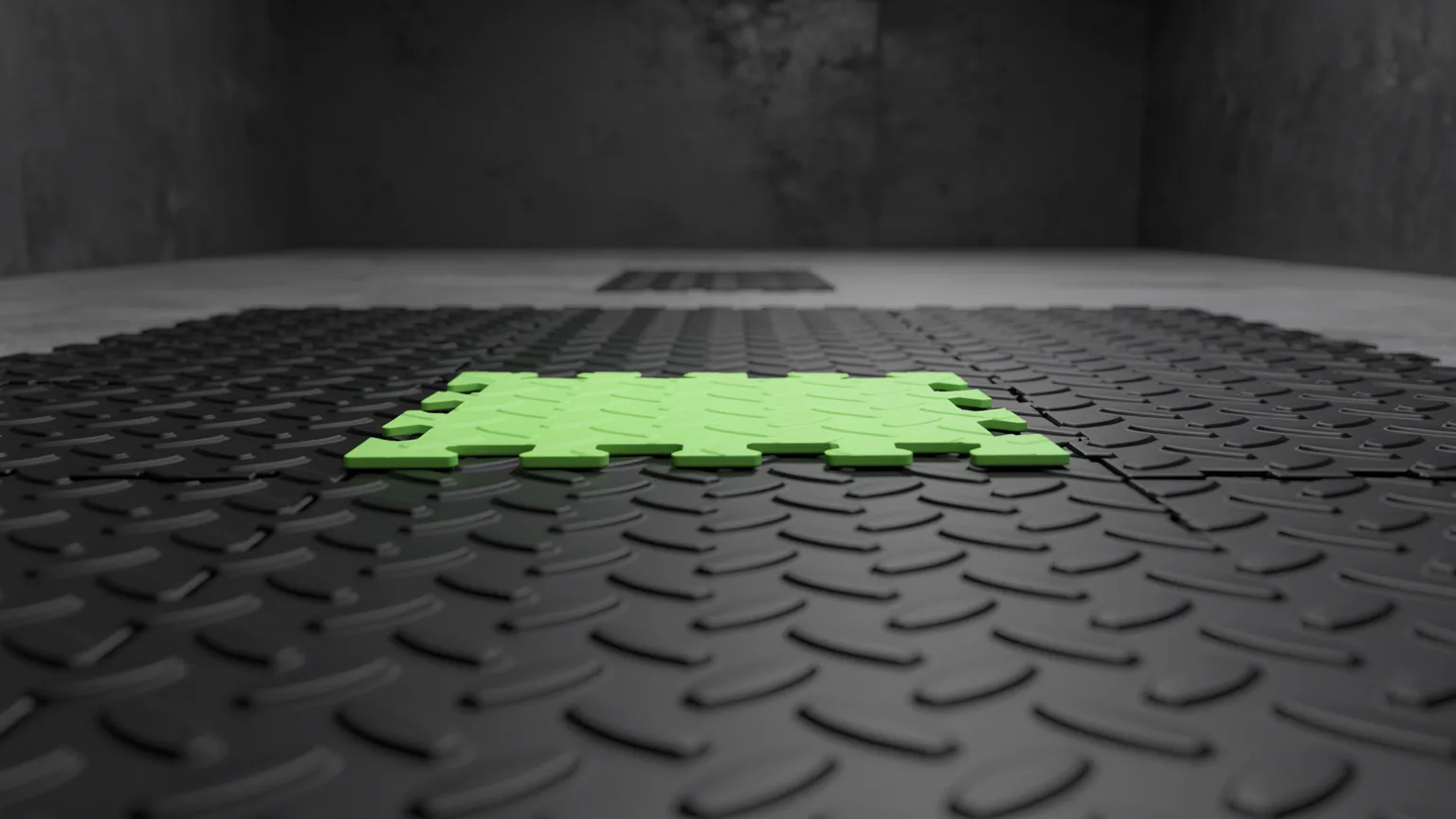
The best home gym flooring in the UK is solid rubber, 12mm or thicker, wherever weights are lowered or dropped, with interlocking foam or rubber-topped tiles for bodyweight, stretching and cardio kit. Makers publish no drop-height ratings for consumer flooring, so this guide ranks on published specification and stated use.
What is the best flooring for a home gym in the UK?
Solid rubber is the better-documented choice for any area where dumbbells, kettlebells or a barbell will be set down, and foam or rubber-topped EVA tiles are the lighter choice for yoga, bodyweight work and cardio machines. The reasoning is about material, not thickness: foam compresses under a concentrated load, while solid rubber resists it. That is reasoning from how the materials are made, not a measured result, and no consumer maker opened for this guide publishes a load or drop rating to confirm or contradict it.
Based on the published specification, price and fit for a stated use, the sensible split looks like this.
- Dumbbells, kettlebells and a rack area: solid rubber. ARKMat states its mat absorbs the impact of free weights; no foam tile maker makes that statement.
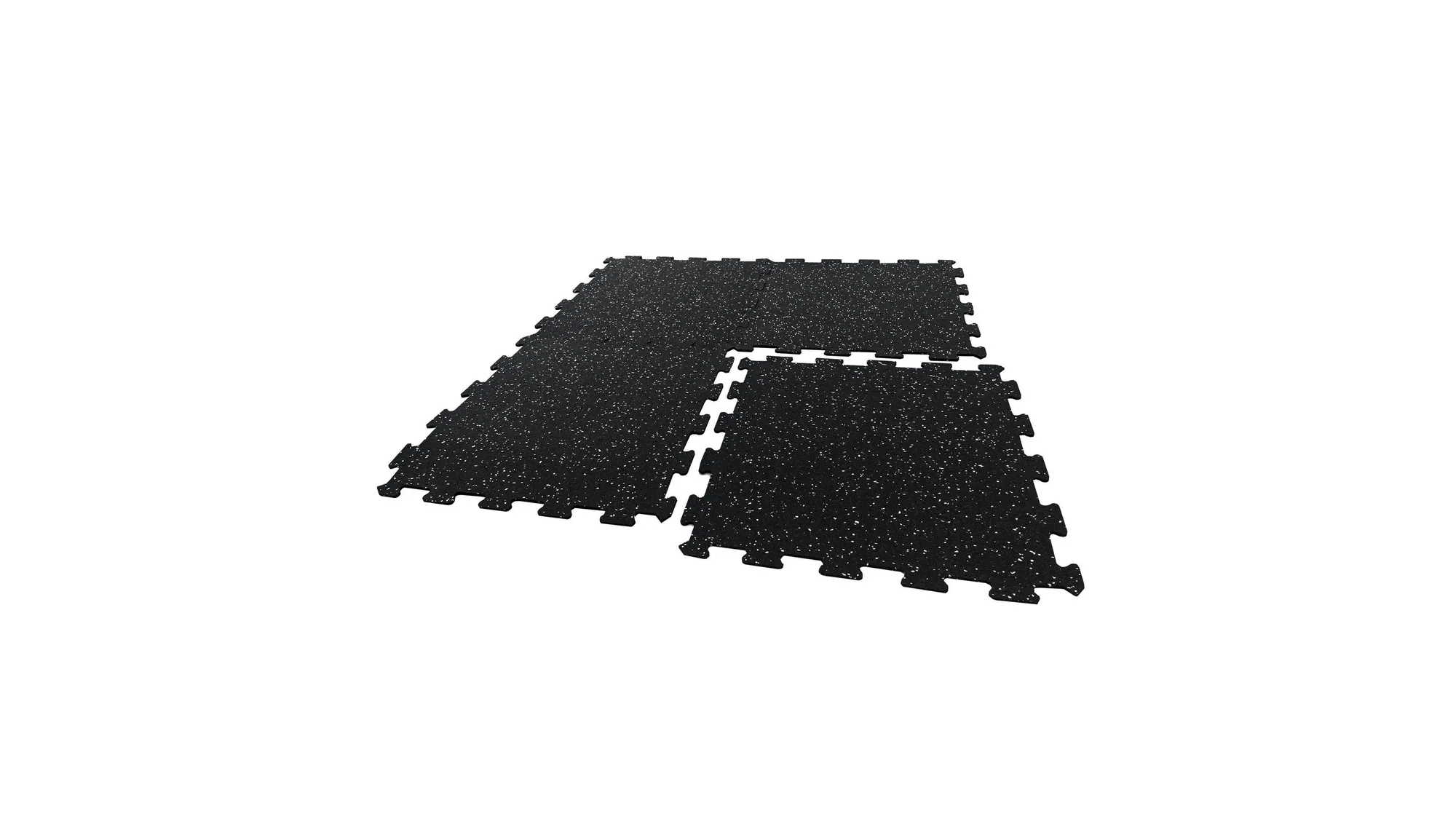
- Yoga, stretching, bodyweight and a spare room: foam or rubber-topped tiles, which are light and easy to lift and relay.
- A whole garage: a roll gives continuous coverage with few seams, but confirm thickness and rubber type on the maker's page first.
- Awkward room shapes: tiles cut and extend more easily than large 6ft x 4ft mats.
Our rubber versus foam guide sets the two materials side by side, and the heavy-weights flooring guide covers the stricter case of heavy loads.
What a home gym floor has to do
A gym floor does three jobs: it protects the subfloor, gives stable footing, and reduces noise and vibration. Cushioning and stability pull in opposite directions, which is why one material rarely does everything well.
Standards bodies treat this as a measurable property. BS EN 14904 is the specification for indoor multi-sports surfaces and lists performance, wear resistance, safety and type-testing among its subjects (BSI). It is written for sports-hall surfaces. None of the consumer matting makers opened for this guide claims conformity to it. It is the yardstick commercial makers such as Regupol quote, not something home mats promise.
Rubber, foam and the formats compared
The table below lines up the products whose maker pages were opened for this guide. A cell reads "Not published" where the maker gives no figure.
| Product | Material | Size and thickness | Weight | Maker statement on weights |
|---|---|---|---|---|
| ARKMat gym mat | Solid natural rubber | 6ft x 4ft (1.82 x 1.22m), 12mm or 17mm | Not published | Says it absorbs the impact of free weights |
| First Mats stable mat | Rubber | 120 x 180cm, 12mm or 17mm | 22.7kg (12mm), 36.25kg (17mm) | None; sold for horses and livestock |
| Regupol everroll classic | PUR-bonded SBR granulate, 20% EPDM | 1,250mm wide rolls of 10, 15 or 20m; 4 to 12mm | About 1.06kg per m2 per mm | Lists free weight training and weightlifting as applications |
| Regupol everroll classic tile | Same material | 600 x 600mm, 6mm | Not published | Same application list |
| Nicoman interlocking mat | EVA foam and recycled rubber, rubber top | 62 x 62cm, 14mm | Not published | Says it can hold the weight of heavy machinery; no figure |
| York Fitness Floor Guards | Foam | 60 x 60cm, 1.3cm | Not published | Floor exercises and under York equipment; no rating |
Rubber rolls
Rolled rubber gives continuous coverage with few seams. Regupol, a commercial maker, describes its everroll classic as a resilient floor covering of PUR-bonded SBR granulate with 20% EPDM colour content, in 1,250mm-wide rolls of 10, 15 or 20m, in thicknesses of 4, 6, 8, 10 and 12mm (Regupol). It lists a fire classification of Efl, slip resistance of R 10 under DIN 51130, and force reduction of up to 16% under EN 14904. The weight of about 1.06kg per square metre per millimetre is a useful rule of thumb: a 12mm roll is roughly 12.7kg per square metre, and a 10m x 1.25m roll at 12mm is roughly 159kg (both calculations from the maker figure). A garage-sized floor of rubber is heavy to move and heavy on a timber structure.
Solid rubber mats
Large rubber mats give fewer joins than small tiles but are awkward in alcoves. ARKMat sells 12mm and 17mm mats, each 6ft x 4ft (1.82 x 1.22m, about 2.22 square metres), and calls them non-porous, non-absorbent natural rubber that will not swell, curl or lift (ARKMat). The 12mm version has an integrated underside handle for moving it; the 17mm version has grooves on the reverse and no handles. The maker also says new mats may carry mould-release residue that household detergent removes, and that moulding marks and flash along the edges can be trimmed and are not a manufacturing defect.
Interlocking foam and rubber-topped EVA tiles
These are the light, cuttable puzzle-edge tiles. Nicoman lists a 62cm x 62cm tile, 14mm thick, made from high-density EVA foam and recycled rubber, free from phthalates, lead and latex, with two detachable edge pieces per mat and pack sizes from 4 upwards that include 9 (Nicoman). York Fitness sells plain foam tiles, 60cm x 60cm and 1.3cm thick, four to a pack with edging (York Fitness). Neither publishes a load or drop rating. Our York Floor Guards review goes through that specification line by line.
How thick should home gym flooring be?
No standard gives a single thickness for home use, and the consumer makers reviewed publish no drop-height ratings, so the honest answer is that 12mm of solid rubber is the thinnest option any of them describes for free weights. What can be said from published figures is below.
- Regupol lists cardio and machine training, free weight training and weightlifting, and indoor cycling as applications for its everroll classic, offers 4 to 12mm, and does not name a thickness for each use.
- ARKMat says its rubber mats, 12mm or 17mm, absorb the impact of free weights, home gyms and treadmills.
- Foam tiles of 1.3 to 1.4cm are marketed for floor exercises, general home use and use under equipment.
Reasoning from this: thickness matters less than material for dropped weights, because a thicker foam is softer, not stronger. A 14mm rubber-topped foam tile and a 12mm solid rubber mat are different products for the same weight set down on them. Solid rubber of 12mm or more is the more defensible choice wherever a weight might land, and the 17mm option from ARKMat adds thickness within the same material. Always read the maker's own limits.
Can you use horse stall mats as gym flooring?
People do, because stable mats are solid rubber in a similar 6ft x 4ft size, but the maker markets them for horses and livestock and says nothing about gym use, so it is the buyer's decision. First Mats lists a 120 x 180cm rubber stable mat in 12mm (22.7kg) and 17mm (36.25kg) with built-in drainage channels, a textured slip-resistant surface, a loose-lay design and a trim-to-fit option (First Mats).
Dividing those weights by the 2.16 square metres of area gives roughly 10.5kg per square metre at 12mm and 16.8kg at 17mm (calculation). The maker quotes a lead time of 2 to 3 working days. It also says anything cut to your own specification cannot be returned unless faulty, which matters if you plan to trim mats to a room. The drainage channels mean a textured surface rather than a flat one, which is worth knowing before putting a bench or rack foot on it.
Do you need gym flooring on concrete?
A rubber layer is still sensible on concrete, to protect the slab, the equipment and your floor finish, and the concrete should be clean, dry and flat first. Concrete is the most forgiving base for weight, but it can hold moisture. An installation guide for commercial Iso-Step gym rolls (a US, glue-down product) asks for dry, clean, smooth and structurally sound subfloors, flat to 4.8mm over 3m, with moisture measured by a relative-humidity test (Acoustical Solutions). Loose-lay mats do not rely on an adhesive, so those limits are a guide to good practice rather than a rule for them. A damp garage slab is still worth checking before covering it with rubber that may trap moisture.
What about timber floors and upstairs rooms?
Timber floors need more caution than concrete, because rubber adds weight and a flexing floor is a poor base. The same installation guide calls for rigid timber floors with no movement and rules out particleboard and chipboard as underlayment for its glued flooring. That is a statement about gluing, not loose mats, but it signals the issue. Rubber roughly adds the weights listed above per square metre before any equipment goes on top.
A joisted floor may not suit a rack and plates, so ask a structural engineer or surveyor before building a heavy setup on an upper floor. See our power rack guide for rack footprints and the home gym safety page for general precautions.
Will gym flooring stop noise reaching the room below?
Not completely: a consumer mat reduces impact noise but should not be expected to remove it. Noise is where flooring is oversold. Regupol describes fitness sound insulation as a layered flooring system with spring and damping properties, tailored to the building structure, not a single mat (Regupol acoustics). Its own everroll classic lists an impact-sound reduction of 19dB for an 8mm roll in a laboratory measurement based on DIN EN ISO 10140. That is a commercial roll, measured in a laboratory, so it does not transfer to a mat on a joisted floor.
Sound between homes is the subject of Approved Document E, which applies to new buildings, alterations and conversions to flats in England (Planning Portal). Read our noise guide and renters guide before lifting anything heavy above a neighbour.
How much flooring do you need?
Measure the area under your equipment plus the space you move in, then compare it with each product's stated coverage. The table shows the coverage the makers state or that follows from their dimensions, with the indicative price divided by area. These price-per-area figures are simple division, not maker claims, and they compare unlike products, since thickness and material differ.
| Product | Coverage | Indicative price | About per m2 |
|---|---|---|---|
| ARKMat 12mm rubber mat | One mat, about 2.22 m2 | Around £53.95 (checked Oct 2026) | About £24.30 |
| Nicoman interlocking mats, 9-pack | 9 tiles of 62 x 62cm, about 3.46 m2 before edge pieces | Around £60 (checked Oct 2026) | About £17.34 |
| York Floor Guards | 4 tiles, 122 x 122cm with edging, about 1.49 m2 | Around £24.99 (checked Oct 2026) | About £16.79 |
| GCM black rubber roll | 10m x 1.5m, 15 m2 (from the product name) | Around £233.99 (checked Oct 2026) | About £15.60 |
| AIRHOP ACTIVE tiles, 12-pack | Not published, no maker page found | Around £129.99 (checked Oct 2026) | Not calculable |
The GCM and AIRHOP ACTIVE listings have no maker page, so their thickness, material and noise performance are unverified. The roll's price per area is not comparable to the others until its thickness is known. These products also appear in the Where to buy block with affiliate links.
What to check before buying in the UK
- Thickness, area and weight on the maker's own page, not a marketplace summary. ARKMat does not publish mat weight.
- Stated use. First Mats sells for horses and livestock; York warrants its tiles for indoor household use only.
- Edges and corner pieces: Nicoman includes two detachable edge pieces per mat; York includes edging in the pack.
- Surface marks and trimming: ARKMat notes possible moulding marks and flash along edges that may need trimming.
- Delivery coverage. York's page says it delivers to England, Wales and lower Scotland, and excludes remote Scotland; First Mats lists a separate Highlands and Islands charge and Northern Ireland as price on application.
- Returns. York offers a 14-day money-back promise on unused items in original packaging, excluding items removed from the box or installed. First Mats excludes anything cut to your own specification unless faulty.
- Warranty. York gives 12 months for manufacturing faults only; ARKMat and First Mats state no warranty on the pages opened.
Gov.uk tells sellers they must refund customers who cancel within 14 days of receiving an online order, and must offer a full refund if an item is faulty, not as described or does not do what it is supposed to (GOV.UK). Check the seller's own terms for how they handle cut-to-size or opened goods.
The storage and layout side is in our garage gym essentials guide.
Who should skip this
If you plan Olympic lifting with regular drops, or a gym above someone else's ceiling, a mat on its own is not an engineered answer. Ask a flooring or acoustic specialist and, for heavy loads on a timber floor, a structural professional. If you only own a yoga mat and a bike, a pack of foam tiles is enough and none of the rubber detail matters.