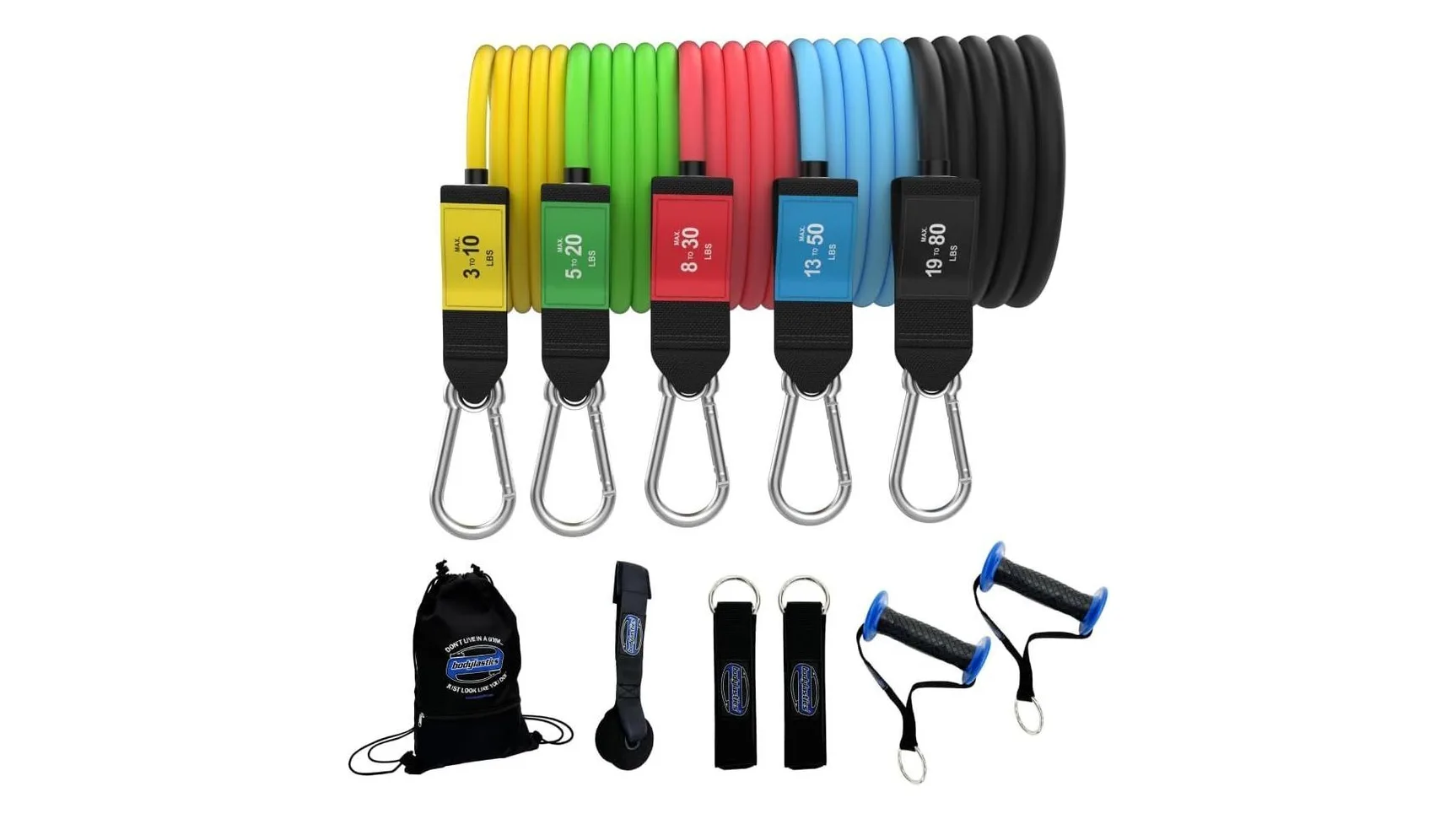
The best resistance bands for home workouts depend on the exercise: loop bands are closed circles, tube bands have handles and clip together, and hip bands are short fabric loops for the legs. Bodylastics publishes enough detail to show how a stackable tube set is rated. This guide is based on published information, not testing.
Do resistance bands count as strength training in the NHS guidelines?
Yes. The NHS lists working with resistance bands, alongside lifting weights, among strengthening activities for adults aged 19 to 64, with a target of at least 2 days a week for all the major muscle groups. The NHS says to work each exercise to the point where you need a short rest before repeating it, and its strength-exercise page suggests building up slowly and gradually increasing repetitions. Bands take little room: see the small apartment setup guide and the strength training checklist.
Which type of resistance band should I buy first?
It depends on what you want to do: loop bands are the simplest, tube bands with handles suit pulling and pressing movements, and hip bands are for lower-body work. This is reasoning from the design of each band, not a ranking from testing.
Loop bands
Loop bands are closed circles of fabric or latex, often sold as a multi-pack of different resistances. With no handles or attachments they are the simplest and cheapest option. The Fit Simplify loop bands in the Where to buy block are around £17 (checked Oct 2026), but no maker page with a specification could be opened, so no resistance figures are given. They are limited to exercises where the band loops around a limb or you step on it.
Tube bands with handles
Tube bands are hollow latex tubes with a clip at each end. Handles, ankle straps and an anchor clip on, and many sets let you stack several bands for more resistance. Because the attachments are part of the system, they suit pulling and pressing movements where you pull from a fixed point.
Hip and glute bands
Hip bands are short, wide fabric loops worn above the knees or around the ankles. They are made for lower-body work and are not a substitute for a full set.
How does Bodylastics rate band resistance?
Bodylastics says a set's total resistance is the sum of all the bands in the set multiplied by two, to account for each end of the band. Its FAQ gives an example: a 5 lb band anchored at one end gives 5 lb when stretched to twice its length and 10 lb at four times its length, so a rating label depends on how far the band is stretched. A band anchored in the middle with a handle at each end gives 10 lb and 20 lb on the two ends.
The same FAQ says an unstretched band is about 54 inches from clip to clip and can stretch to about four times that length before a safety cord, which Bodylastics calls Snap Guard, stops further stretch. It says every band has had the cord since 2011-2012 and describes how to check for it by folding back the clip webbing and shining a light down the tube.
What do Bodylastics band sets list?
Bodylastics lists its sets by number of bands and stated maximum tension. The maker's collection page also states a minimum tension of 3 lb for all sets and prices in US dollars.
| Bodylastics set (maker's collection page) | Bands | Stated maximum tension |
|---|---|---|
| 5 Band Basic Series | 5 | 190 lb |
| 5 Band Pro Series | 5 | 190 lb |
| 6 Band Pro Series (Legacy colours) | 6 | 280 lb |
| 7 Band Pro Series | 7 | 400 lb |
| 16 Band Pro Series | 16 | 1,040 lb |
The pound figures are the maker's, and totals are stack ratings across all bands, not what a single band delivers. The Resistance Band System in the Where to buy block is around £89 (checked Oct 2026); confirm which set that listing contains, as the maker's collection page does not list accessories for any set.
What are the Bodylastics warranty terms?
Bodylastics' terms (effective April 2025) say a band or component that fails during regular use in the first 90 days is replaced free of charge, with claims by email. After 90 days, replacements are bought on Amazon at a discounted price, which the page says is set at cost. If Amazon cannot ship to a non-US address, Bodylastics says it cannot supply a replacement there. Check this before buying from outside the US, and note that UK consumer law applies separately: GOV.UK business guidance says a seller must offer a full refund for an item that is faulty or not as described, and customers buying at a distance can cancel up to 14 days after delivery.
How should I inspect and look after bands?
Inspect bands before use and stop using any with cracks or splits. Bodylastics says bands that have gone unused for a long time should be checked closely for cracks or splits in the latex, and that you should stop using a damaged band and contact the company. It says white powder on its bands is talc left over from manufacturing and is cosmetic, and that small lumps from its dipping process do not affect integrity. It recommends threading bands only through the padded loop of its anywhere anchor, so they can stretch and contract safely, and warns against threading them against a hard surface.
How does the NHS suggest building up?
The NHS suggests starting gently, even if you have not exercised in a while, and building up slowly. Its strength-exercise page aims to increase the repetitions of each exercise gradually over time, to move slowly and with control, and to make exercises harder only once they feel manageable. Its examples include biceps curls and wall press-ups, and it says to aim for these at least twice a week. Bands suit this approach on paper because a lighter band or less stretch means less resistance, but neither the NHS nor Bodylastics gives a band-by-band progression plan, so a qualified trainer is the person to ask.
Single Bodylastics bands are listed by the maker at roughly 8 to 17 US dollars on its warranty page, which adds that prices may change with tariffs. That is a US store price, not a UK price, so the retail cost of a set in the UK will differ.
What to check before buying?
- How resistance is quoted. A total across a stack, a per-band rating and a stretch length are different things. Ask which one a label means.
- Safety cord or sleeve. Bodylastics describes an inner cord. If a set has no such feature, the maker's documents should say how the band is protected.
- Anchors. Check what the set includes and how it is meant to be fixed. Bodylastics says to use the padded loop of its anchor only.
- Latex. Many bands are latex, and Bodylastics refers to latex bands. If latex is a concern for you, check the product details first.
- Delivery and warranty route. Bodylastics' store is priced in US dollars, so confirm UK delivery, import costs and who handles replacement.
Who should skip bands?
Bands change resistance by stretch, not by a fixed weight, so progression is harder to set in kilograms. If you want a measured weight on the handle, see best adjustable dumbbells or best kettlebell. For a wider plan see building a home gym on a budget. Consult a doctor before starting an exercise programme, and a qualified trainer for technique.