Choose resistance bands by format first: closed loops suit leg and hip work, tube bands with handles suit pulling and pressing, and flat bands suit rehab-style moves. Then check the resistance range, latex content and attachments. Bodylastics and TheraBand publish the details used below.
This guide draws on maker pages and NHS guidance. Nothing here was tested, and the site does not test products.
What types of resistance band are there?
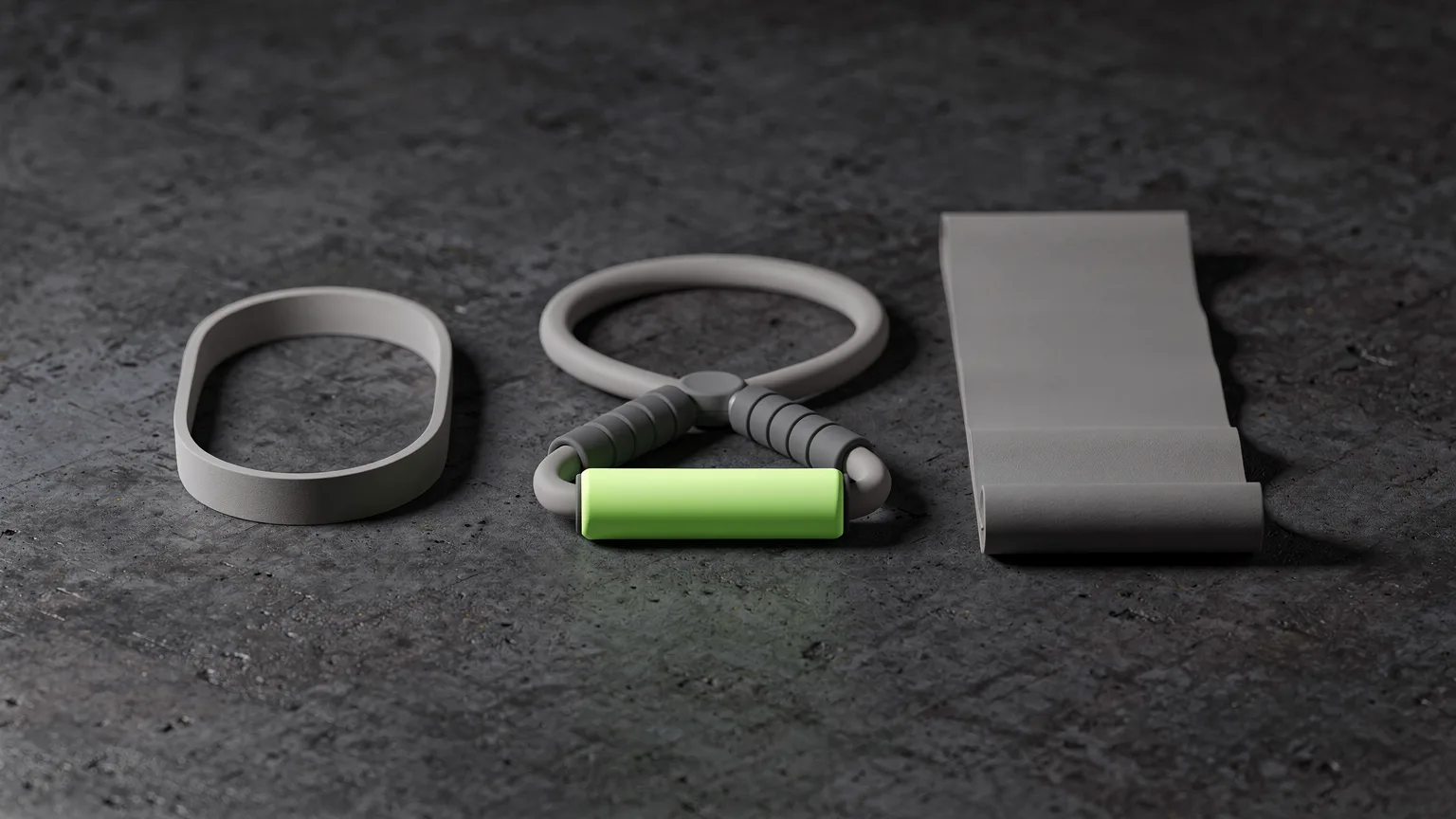
The main formats are closed loops, tube bands with handles, and flat bands. Each is built for different movements, so the format matters more than the brand.
- Loop bands: a continuous circle that you step on, wrap round a limb or hold in your hands. TheraBand sells Band Loops with a three-inch width, which it says greatly reduces ankle and leg roll-up.
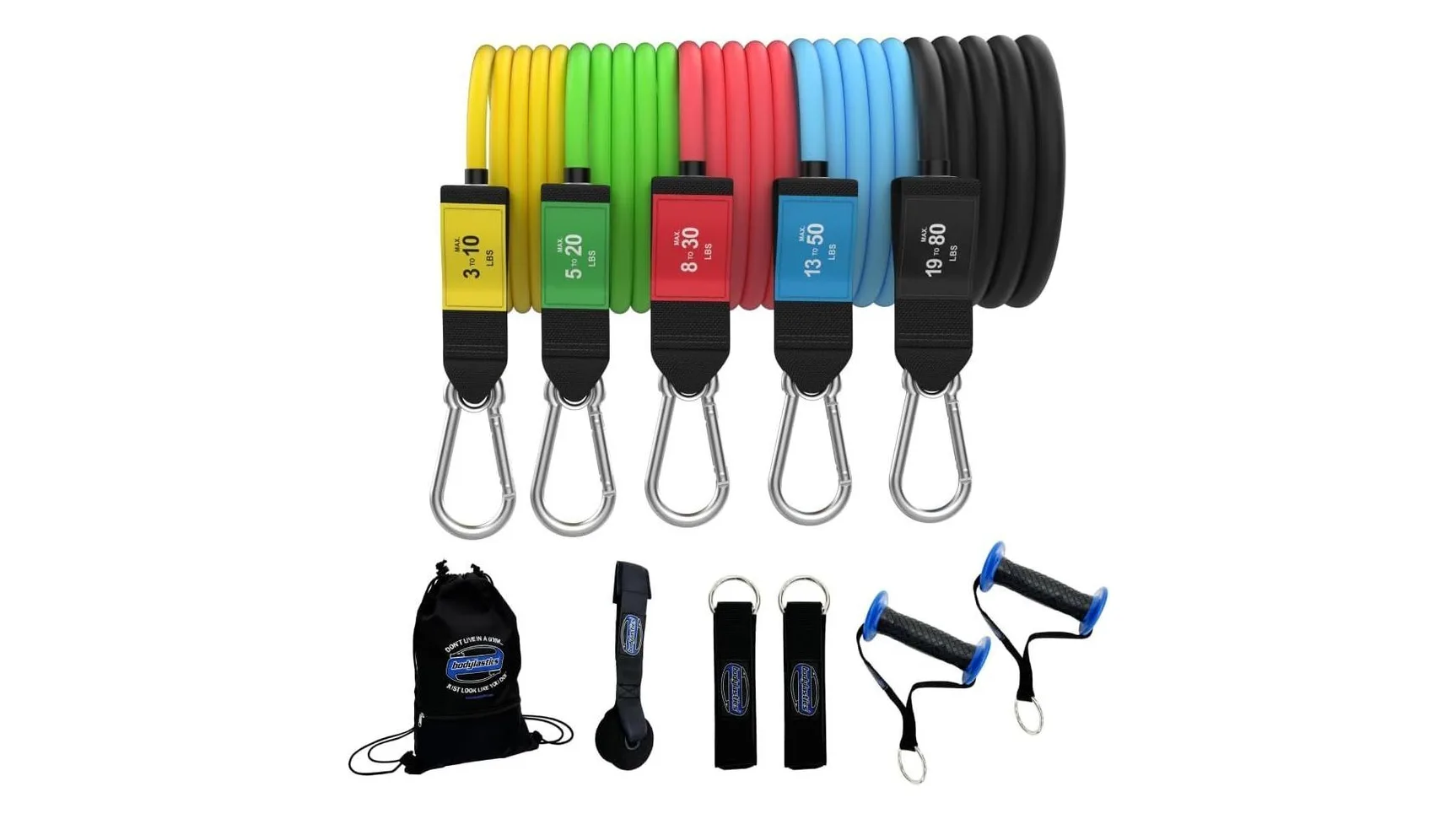
- Tube bands with handles: a hollow latex tube with a clip at each end. Bodylastics' set lists two handles, two ankle straps and a door anchor, so you can pull from a fixed point.
- Flat bands: a strip of elastic you tie, loop or hold. TheraBand's loop page compares its Band Loop resistance with a Flat band, saying a loop is twice that of a flat band.
For a ranked set of options, see the best resistance bands for home workouts guide.
How do you read resistance band ratings?
Read a rating as a range, not one number, because a band's pull grows as it stretches. Bodylastics' FAQ says total set resistance is the sum of all the bands multiplied by two, to account for each end of the band.
Its example: with one end anchored, a 5 lb band gives 5 lb at twice its length and 10 lb at four times its length. Anchored in the middle with a handle at each end, each end gives the resistance of two bands, 10 lb and 20 lb in the example.
That means a set labelled 190 lb is a stack rating across all bands, not what one band delivers. Compare like with like: the same stretch, the same anchor.
How do TheraBand and Bodylastics compare?
They sell different formats. Bodylastics sells tube sets, and TheraBand sells loops, CLX and other lines. The figures below come from each maker's own page.
| Product | Format | Stated resistance | Material | Included |
|---|---|---|---|---|
| Bodylastics 5 Band Pro Series set | Tube bands | 3-10, 5-20, 8-30, 13-50 and 19-80 lb per band; 190 lb max tension for the set | Latex, made by a continuous dip process per the maker's FAQ | 2 handles, 2 ankle straps, 1 door anchor, 1 bag |
| TheraBand Band Loops | Closed loop | Super Light (2.4 lb) to Elite (14.2 lb) | Natural latex formulation | Loop only |
| TheraBand CLX | Band with spaced grip loops | Colour-coded levels; the page does not give the number | Latex-free, powderless | Band, loop, tubing with handles and anchor are listed as a bundle |
TheraBand does not list the colour names or the loop lengths on the pages used here, so none are given. Bodylastics' set is the Resistance Band System in the Where to buy block, around £89 (checked Oct 2026). Confirm which set a UK listing contains before you order, because the maker's pages are written for US buyers.
Do you need latex-free resistance bands?
Only if you react to latex. Bodylastics describes its bands as latex made by repeated dipping, and TheraBand describes its Band Loops as natural latex. TheraBand lists CLX as latex-free and says it has identical performance and resistance to its latex products.
The NHS allergy page lists symptoms that can appear within minutes or after a few hours, including itchy or red skin, a raised rash, wheezing and swelling of the lips, mouth or throat. It says to call 999 if your lips, mouth, throat or tongue suddenly swell, and to see a GP if you think you may have an allergy.
How many bands do you need to start?
A set of several resistances is the practical starting point, because different muscles need different loads. Bodylastics' Pro Series set spans five bands from 3-10 lb up to 19-80 lb, so a small upper-body exercise and a squat or row can each use a suitable band.
The NHS says to build up slowly and aim to gradually increase the repetitions of each exercise over time. Bands fit that: move to the next band once the current one no longer challenges you. Our progressive overload at home guide explains the idea in more detail.
What should you check before you buy?
Check the format, the resistance range, the material, the attachments and the care guidance. Bands wear out, so the maker's inspection advice matters.
- Attachments: a door anchor and handles open up pulling exercises. Loops need neither.
- Stretch limit: Bodylastics says its bands are about 54 inches clip to clip and stretch to about four times that length, where an internal Snap Guard cord stops further stretch.
- Inspection: Bodylastics advises checking bands that have not been used for a long time for cracks or splits in the latex, and not using them if you find any.
- Warranty: Bodylastics' warranty pages do not mention UK buyers, so check cover with the seller.
The Bodylastics Resistance Band System review sets out what the maker states about that set in more detail.
Where do resistance bands fit in a home gym?
They fit anywhere, which makes them a common first purchase. A set stores in a bag, which suits the small apartment home gym setup approach, and they cover the strengthening activity the NHS recommends, on at least two days a week for adults aged 19 to 64.
See the strength training equipment checklist for what to add once bands are no longer enough. If you have a health condition or an injury, speak to a GP or physiotherapist first and follow the maker's instructions.