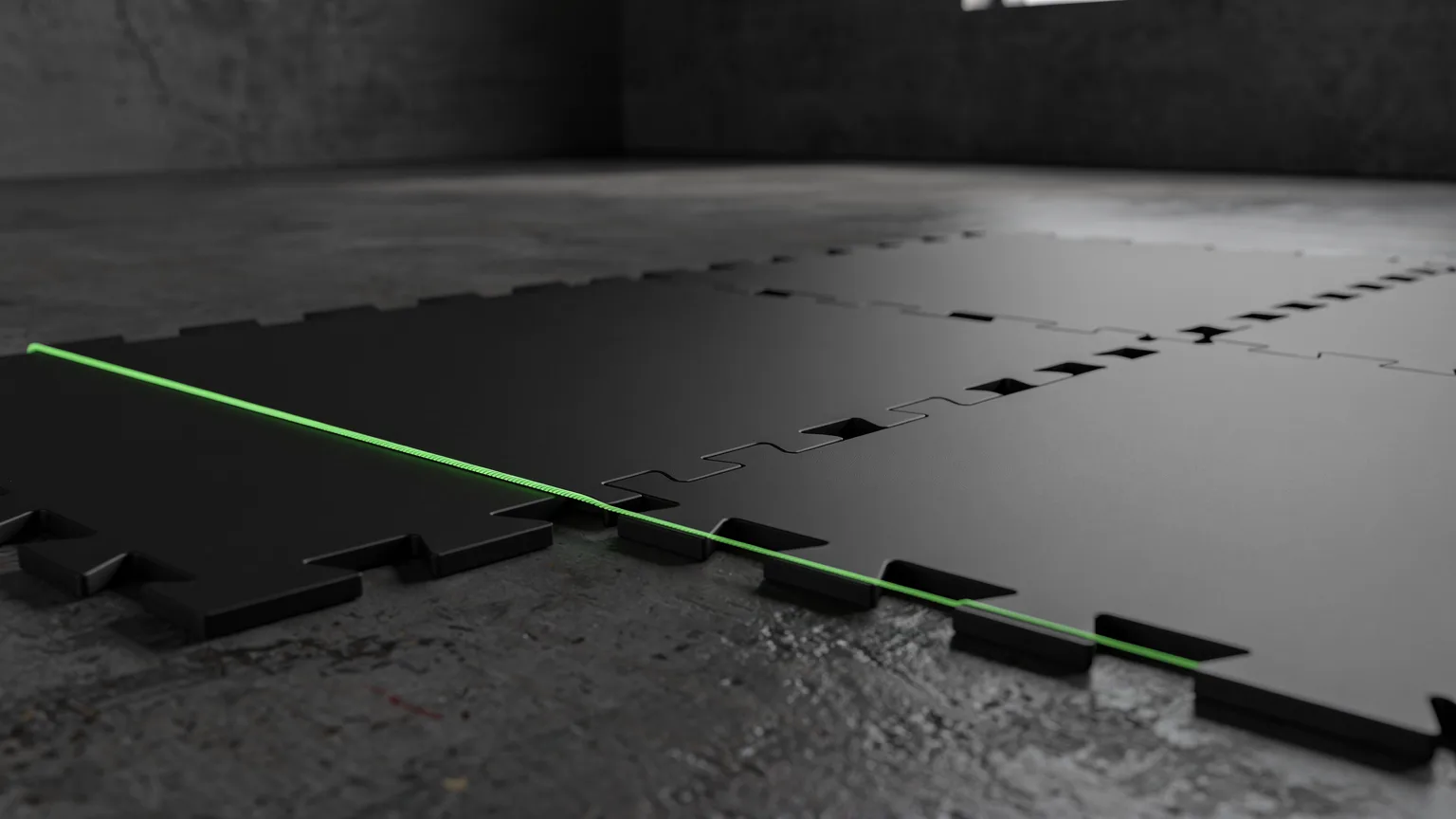
Laying home gym flooring means measuring the room, preparing a clean, dry, level subfloor, letting the material relax, then cutting and laying it with a small gap at the walls. This guide covers those steps using flooring makers' installation instructions, not a product ranking.
How do you measure a room for gym flooring?
Measure the length and width of the training area, not the whole room, then divide by the size of your tile, mat or roll width and round up. Rep Fitness advises measuring and planning the layout around obstacles such as columns and doorways, which cuts waste and cuts mistakes.
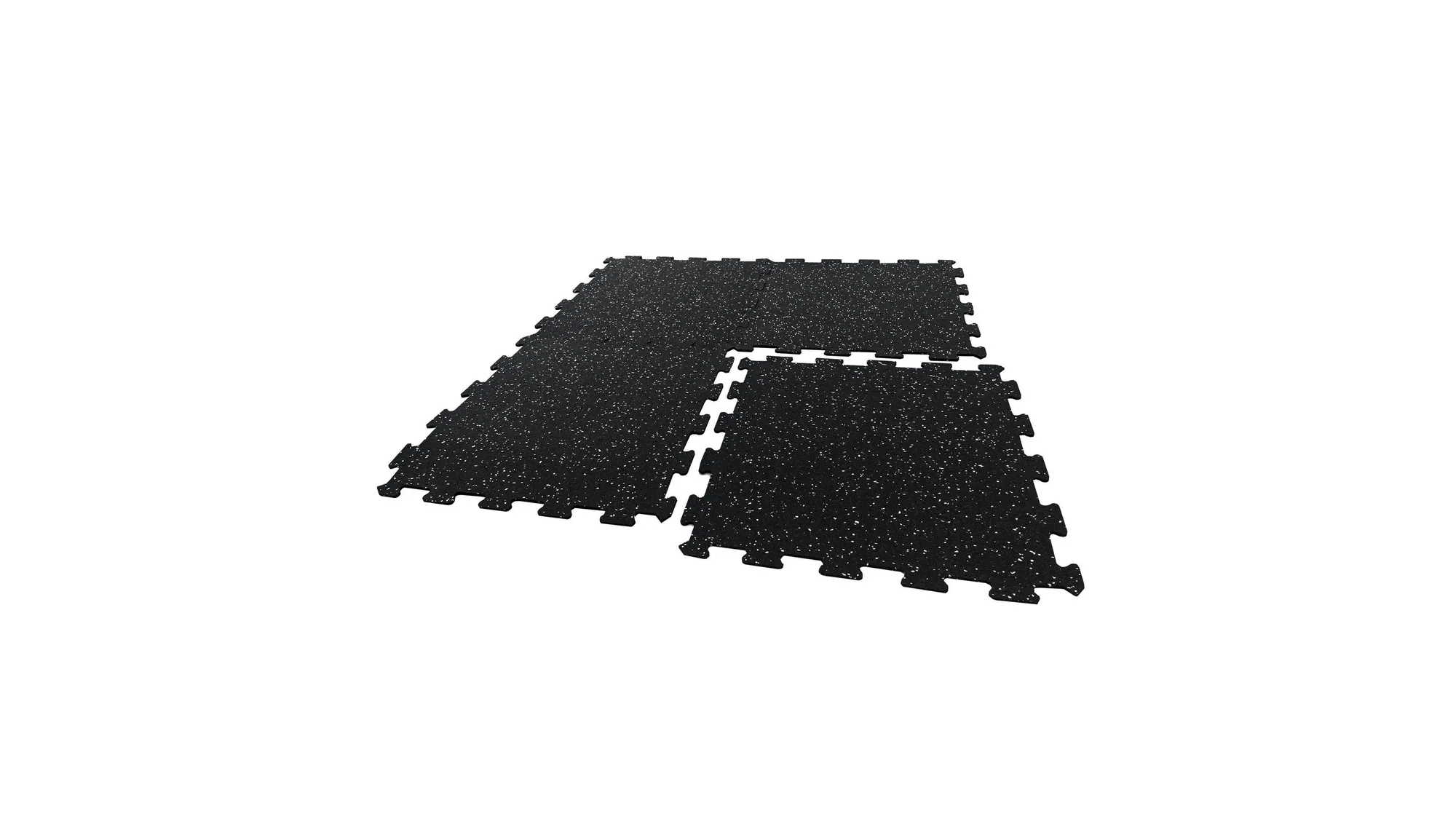
Here is the arithmetic for a 3.0 m by 2.4 m area (7.2 square metres) using 62 x 62 cm tiles, the size Nicoman lists for its 14 mm rubber-topped foam mats. Each tile covers about 0.384 square metres. Along 3.0 m you need five tiles (4.84 rounded up) and along 2.4 m you need four (3.87 rounded up), so 20 tiles in a full grid, which covers about 7.7 square metres. That is a calculation, not a maker figure.
Other formats work differently. ARK lists its rubber gym mats at 6 ft x 4 ft (1.82 x 1.22 m), about 2.22 square metres each, in 12 mm or 17 mm. Regupol lists its everroll classic at 1,250 mm wide in 10, 15 or 20 m lengths, from 4 to 12 mm thick. A 10 m roll is therefore 12.5 square metres, so it suits a long garage floor rather than a small room.
| Format | Maker-listed size | Thickness listed | What the page says about laying |
|---|---|---|---|
| Nicoman rubber-topped foam tile | 62 x 62 cm, two detachable edge pieces per mat | 14 mm | No laying or cutting instructions published |
| ARK rubber gym mat | 182 x 122 cm (about 2.22 sq m) | 12 mm or 17 mm | No installation steps; edge flash can be trimmed with a knife |
| Regupol everroll classic | 1,250 mm wide; 10, 15 or 20 m long | 4, 6, 8, 10 or 12 mm | No installation notes on the page |
| Acoustical Solutions Iso-Step rolls | Rolls (installation guide) | Not stated in the guide | Full installation guide published |
The consequence is that the laying advice below comes from the two roll makers that publish guides (Acoustical Solutions and Stomp Roll) and from Rep Fitness. Where your product's maker publishes nothing, ask the seller for its instructions before you start.
What does a subfloor need to be before you lay gym flooring?
It needs to be dry, clean, smooth, level and structurally sound. Both roll makers say the same: remove dust, oil, paint, wax and old adhesives, and do not clean with solvents if you plan to glue. They also say the surface should be flat to the equivalent of 3/16 inch in 10 feet, which is 4.8 mm over 3.0 m.
Both guides are published in the United States for rubber rolls, so their units are imperial and their moisture test (ASTM F2170) is American. They do not give UK humidity limits. Treat their figures as what the makers require for those products, and ask your own product's maker or seller about moisture.
| Check | Maker requirement | Source |
|---|---|---|
| Room temperature | At least 18°C (65°F) for 48 hours before, during and after installation | Iso-Step guide; Stomp Roll guide |
| Flatness | 3/16 in in 10 ft (4.8 mm in 3.0 m) | Iso-Step guide; Stomp Roll guide |
| New concrete | Cure at least 28 days; 3,000 psi compressive strength | Iso-Step guide; Stomp Roll guide |
| Patching compound | Portland-based only; gypsum-based not acceptable | Iso-Step guide; Stomp Roll guide |
| Concrete joints and cracks | Fill with approved patching compound; use expansion joint covers over expansion joints | Iso-Step guide |
| Wood subfloor | Double construction, minimum 1 in (25 mm), rigid, with at least 18 in (46 cm) of ventilated air space below | Iso-Step guide; Stomp Roll guide |
| Underlayment | Plywood underlayment grade; particleboard, chipboard, Masonite and lauan not suitable | Iso-Step guide; Stomp Roll guide |
Can you lay gym flooring on carpet or hardwood?
Not directly on carpet, according to Rep Fitness, which says carpet can cause instability. Over hardwood, Rep Fitness suggests a paper or foam underlayment, and it says not to use floor glue on hardwood because it may damage the wood. Over concrete in a basement or garage it suggests considering a subfloor for moisture and cushioning.
The flooring makers' wood-subfloor requirements above apply to glued roll installations. For a loose-laid tile on an existing floor, the practical questions are whether the surface is flat and whether the floor will mark. If you rent, the renters' guide covers equipment choices, and your tenancy agreement decides what you may stick down.
Is your home old enough to need an asbestos check?
HSE says asbestos may be part of any commercial or domestic building built or refurbished before the year 2000, and it was banned in 1999. HSE lists floor tiles among the places it can be found, and says not to repair or remove it yourself unless you are trained for non-licensed work.
That matters for subfloor preparation, because the roll makers tell installers to mechanically remove old adhesives by scraping or sanding. The Iso-Step guide carries its own warnings about asbestos, lead and silica dust, and says not to sand or dry-sweep suspect flooring. If old tiles or adhesive in a pre-2000 home need removing, stop and get advice first. Laying a floor on top, without disturbing it, avoids that work, and HSE says material in good condition is often best left alone.
How long should flooring rest before you cut it?
Rolls need 24 to 48 hours unrolled and relaxing before cutting, and the makers say to keep the material and adhesive at room temperature for at least 48 hours before installation. Rep Fitness gives 24 to 48 hours for acclimatising flooring generally. Both roll guides say store rolls lying flat, because rolls stored on end can curl at the edges.
After rough cutting, the Iso-Step and Stomp Roll guides say to let the cut pieces relax in position for a minimum of two hours, then trim the seams. Tiles and mats are not discussed in those guides, so for foam tiles rely on the maker of your product. The point for planning is that flooring is not a same-hour job: order early and leave the pieces in the room.
How do you lay and cut it?
- Assume the walls are not straight. Both roll makers say to snap a chalk line for the first seam, set where the first edge should sit.
- Cut with spare length. The guides say to cut rolls with a few extra inches to run up the wall, overlap end seams by about 3 to 6 inches and trim after the pieces relax.
- Leave a wall gap. Stomp Roll says to leave a 1/4 inch (about 6 mm) gap at walls for expansion, usually covered by the wall base. Rep Fitness gives the same 1/4 inch for rubber or foam.
- Butt the seams. The roll makers say overlap the next roll by no more than 1/8 inch (about 3 mm), then work it back for a tight, gapless seam, without over-compressing it, which causes peaking.
- Cut with a sharp knife. Rep Fitness says use a utility knife with a sharp blade and measure twice. ARK says mould flash on its mats can be trimmed with a suitable knife.
- Work outward from the centre for tiles. Rep Fitness suggests starting in the centre of the room and placing pieces in a balanced pattern.
Should you glue, tape or loose-lay gym flooring?
For a permanent roll floor the makers describe glue, and for a temporary or rented floor they describe double-sided tape. Acoustical Solutions recommends its own adhesive for permanent installations and says tape may not hold in every situation, because rubber expands and contracts with temperature and humidity.
The glue method in both guides uses a 1/16 inch notched trowel, spreads only as much adhesive as can be covered and rolled within 30 minutes, and rolls the floor with a 75 to 100 lb (34 to 45 kg) roller. Foot traffic is kept off for 24 hours and rolling loads for 72 hours. The tape method needs tape at least 2 to 3 inches wide on both sides of each seam.
Rep Fitness says tape suits temporary or leased spaces, needs no drying time and removes without residue, while glue suits permanent installs. Interlocking tiles such as Nicoman's use their own edges and edge pieces, so check whether the maker describes fixing at all.
How heavy is gym flooring to carry?
Heavier than most people expect, so plan the carry. Rep Fitness gives about 88 lb (40 kg) for a 4 ft x 6 ft mat and about 8 lb (3.6 kg) for a tile. Regupol gives about 1.06 kg per square metre per millimetre, so an 8 mm roll is roughly 8.5 kg per square metre, and a 10 m roll at 1,250 mm wide is about 106 kg (calculation from the maker's figure).
HSE says the law sets no specific weight limit for manual handling, and asks you to avoid or assess hazardous lifting. For a roll or a stack of mats, use two people and a trolley. Weights, thickness and noise are compared in the home gym flooring buying guide.
What happens after you lay it?
Clean the surface and check the edges. ARK says new mats may carry mould release agent residue that household detergent removes. Rep Fitness suggests sweeping or vacuuming and mopping rubber with mild detergent, and says to use an extra mat layer where heavy weights are dropped. Its commercial thickness guide lists 8 mm for standard gym use, 9 mm for occasional bumper plate drops and 12 mm for Olympic lifting or HIIT.
Choosing between rubber and foam is a separate decision, covered in rubber flooring vs foam mats and flooring for heavy weights. For garage floors, see garage gym essentials, and for noise the ventilation and noise guide.
Who should skip laying it themselves?
Skip a glued roll floor if you rent, if the subfloor is damp, uneven or an unknown old material, or if the home predates 2000 and you would be disturbing old tiles or adhesive. The roll makers' guides are written for trained installers and their own adhesive, so a DIY glue-down is best left to a professional or avoided in favour of loose tiles.
None of these makers publish a UK moisture limit in the pages read. If you have a damp basement or garage, ask a flooring professional rather than relying on this page.