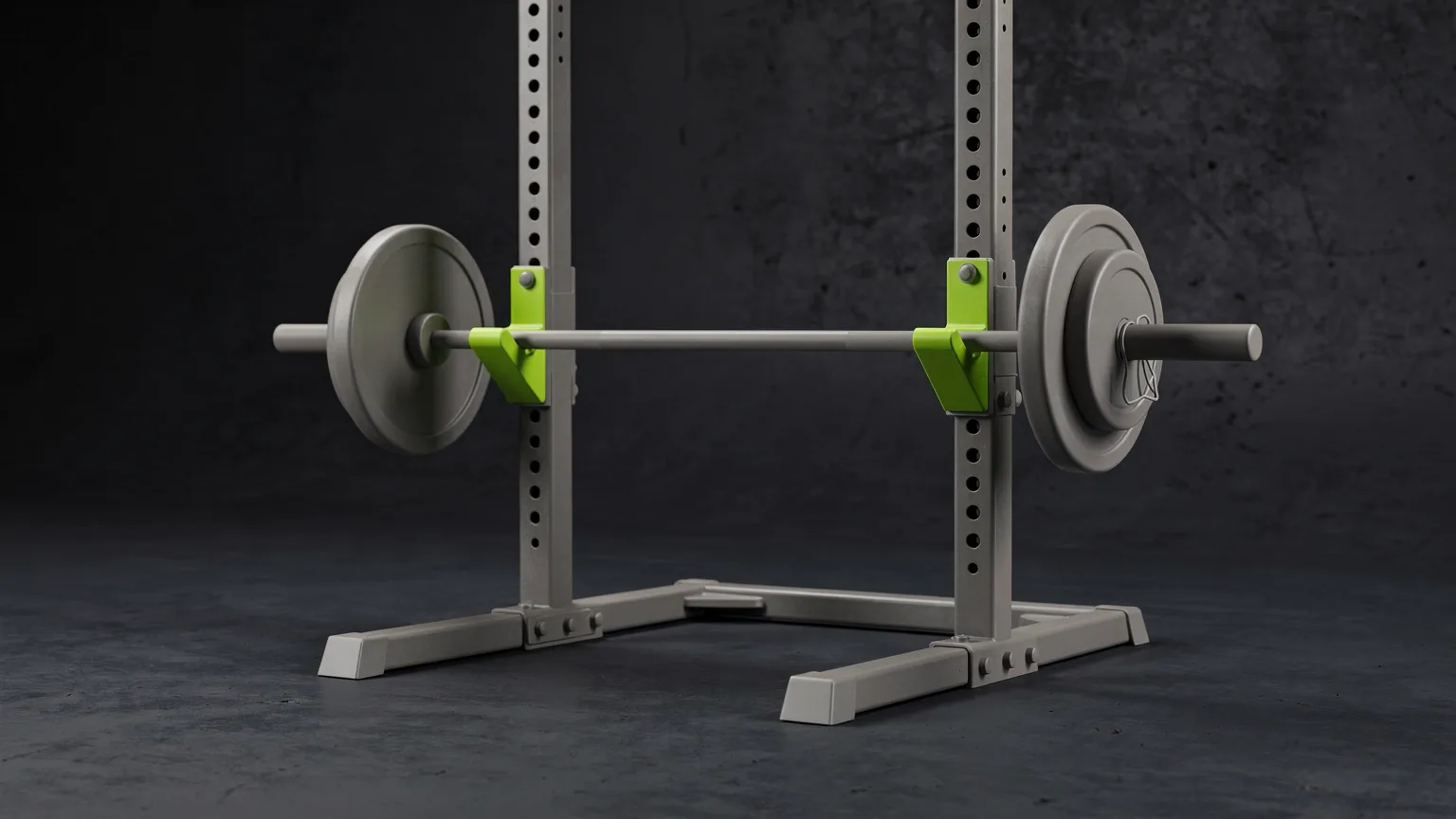
Garage gym essentials, in buying order: measure the space and check any fixings, protect the floor, add basic resistance equipment, then consider a bench and rack only if you plan barbell work. Published rack dimensions show how little spare height some frames leave, so measure before ordering.
How do I check a rack will fit my garage?
Compare the maker's published height, width and depth with your own measurements, then allow extra room above and around the frame. Measure floor area, ceiling height at the exact spot where the rack will stand, and the width of every door the parts must pass through.
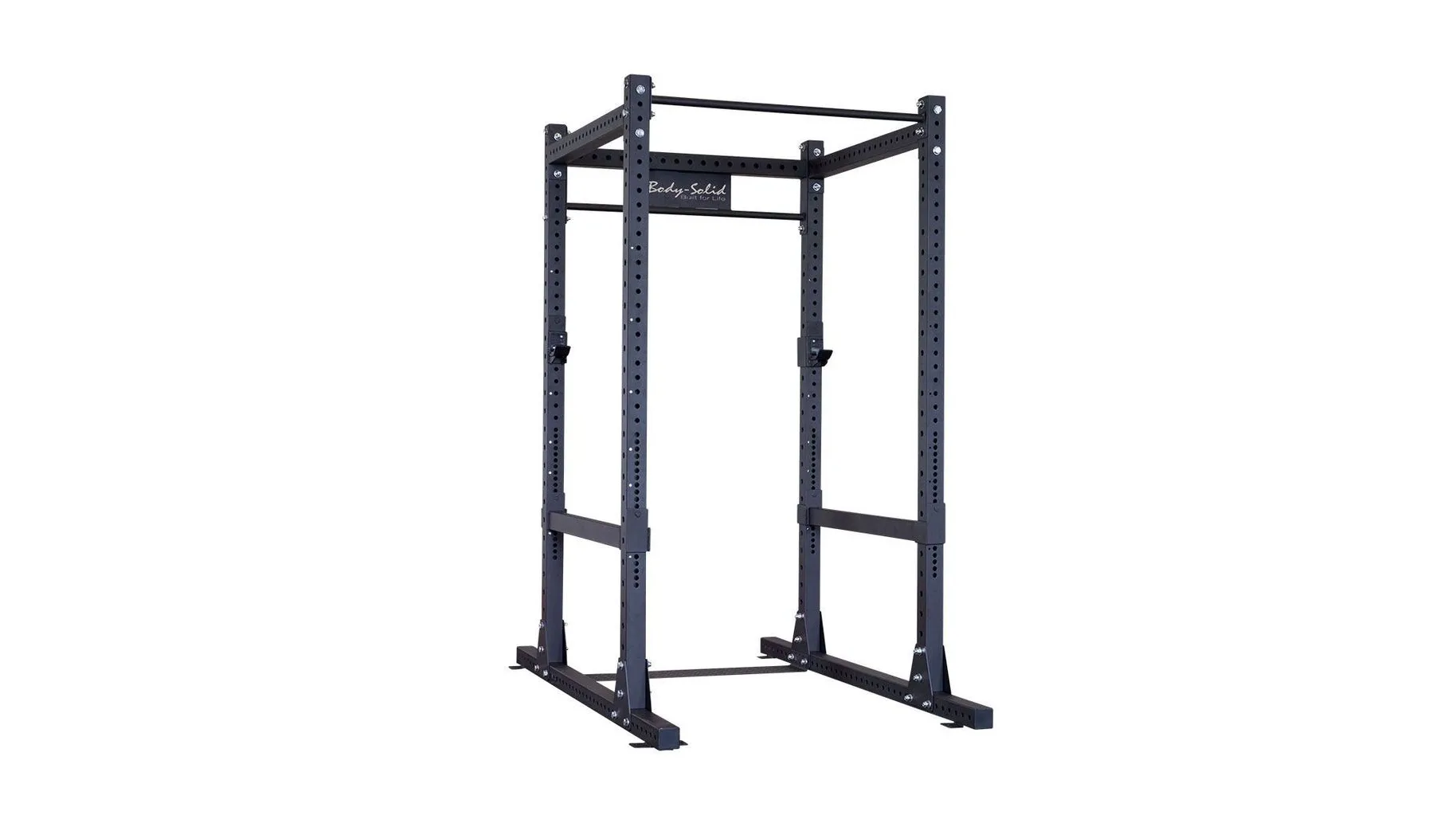
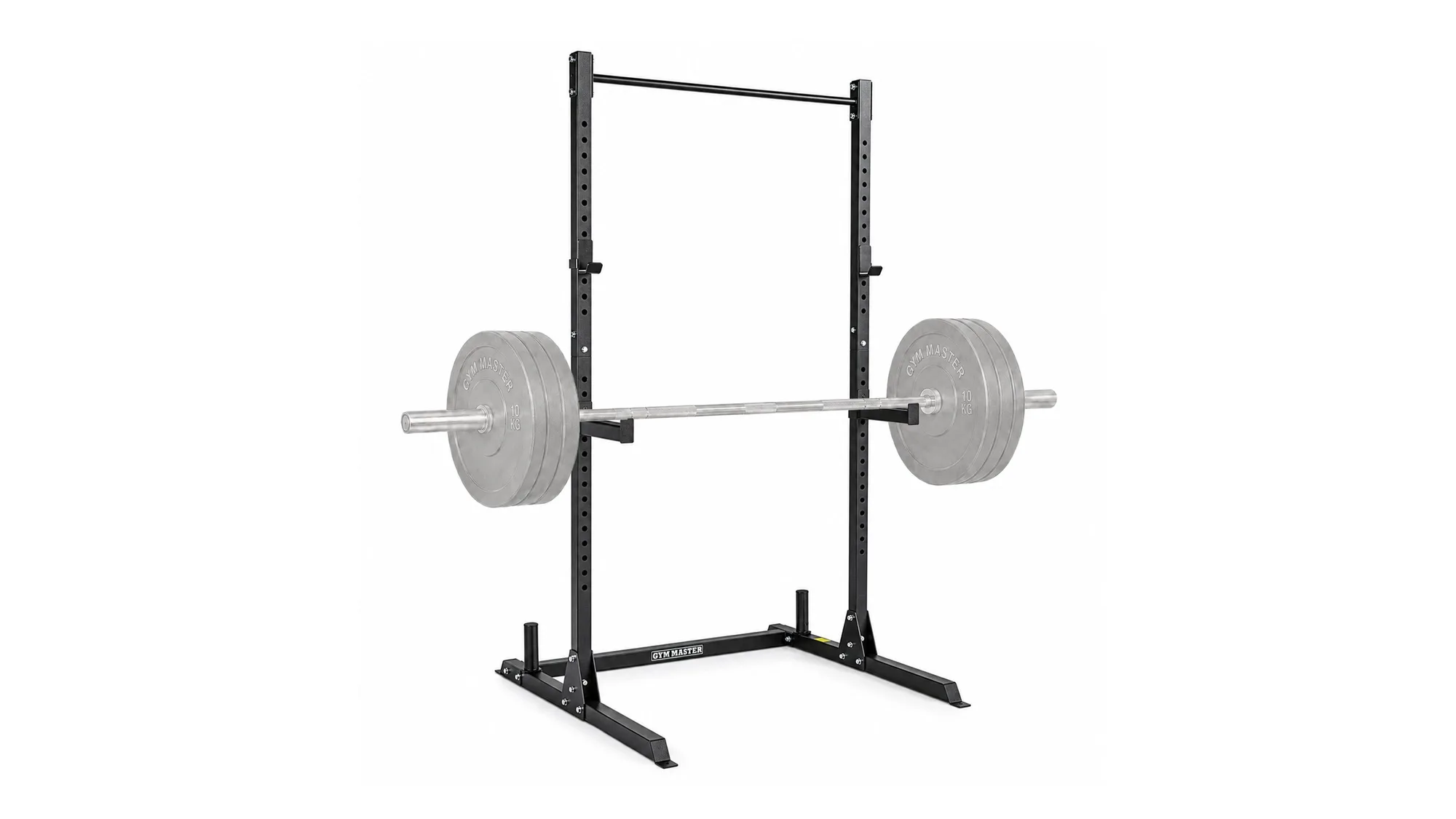
Gym Master lists its adjustable squat rack cage at 220.5cm high and 121.5cm wide and deep. Body-Solid's table for the SPR1000 gives 2267mm high, 1340mm wide and 2057mm long. Neither figure includes the room you need to load and unload, or the headroom for a pull-up. As arithmetic only: under a 240cm ceiling, a 220.5cm frame leaves 19.5cm of spare height, and a pull-up grip takes you above the bar.
If the garage is also used for storage or a vehicle, decide what stays and what moves. GOV.UK's fire safety guidance says to make sure exits are kept clear and to check there is nothing in corridors or stairways that could catch fire. That is written for the home generally, but it is a sensible test for the route out of a crowded garage too.
What should I buy first for a garage gym?
Buy floor protection and simple resistance equipment first. Garage floors vary, and heavy equipment or dropped weights can mark or damage them, so options and trade-offs are in the home gym flooring guide, the heavy-weights flooring guide and rubber flooring vs foam mats. Check the flooring maker's guidance on the weights and equipment their product is intended for.
The NHS recommends muscle-strengthening activity on at least 2 days a week, working all the major muscle groups, and lists lifting weights and resistance bands among the options. Dumbbells, kettlebells and bands meet that guideline without needing a rack. See the adjustable dumbbells guide, the kettlebell guide and the resistance bands guide. If you are new to training, the beginner's guide explains what can wait.
Do I need a power rack in a garage gym?
Not necessarily. A rack matters when you lift a loaded bar above or across your body, because it provides supports and safeties at set heights, but dumbbells, kettlebells and bands meet the NHS muscle-strengthening guideline without one. A rack is the biggest space and money commitment in most garage gyms, so it comes later.
Before choosing, read how to choose a power rack and power rack vs half rack. Benches are covered in the weight bench guide.
Two racks compared from maker pages
The table lists only what each maker publishes. Where a figure is missing, the maker does not state it on the pages read.
| Item | Gym Master adjustable squat rack cage | Body-Solid SPR1000 power rack |
|---|---|---|
| Published dimensions | 220.5cm high, 121.5cm wide, 121.5cm deep | Table: 2267mm high, 1340mm wide, 2057mm long |
| Frame | 50x50mm reinforced steel tube, wall thickness not stated | 3" x 3" 11-gauge steel mainframe |
| Stated load | J-cup and spotter max load 200kg; pull-up bar 120kg | 1000lb (about 454kg) per the maker's data sheet |
| Safeties | J-cups, spotters and pull-up bar listed | Two J-cups and two safety spotter bars included |
| Height adjustment | 28 settings, 45cm to 197.5cm, 5cm apart | 1 inch spacing on spotter bars and front bench-press holes; 3 inch on upright side holes |
| Fixing | Corner anchor points, bolts supplied; maker strongly recommends bolting to the ground | Optional Jammer Arms require the rack to be bolted to the floor |
| Warranty | Not published on the page | Frame and welds: lifetime, per the maker's data sheet |
| Use stated | Not suitable for commercial use | Commercial application |
| Indicative price | Around £99.99 (checked Oct 2026) | Around £1,096.99 (checked Oct 2026) |
Body-Solid's page also lists its weights and heights inconsistently (350 lb and 282 lb; 90 in and 89.3 in) and showed the item as temporarily out of stock when read, so confirm details with the maker or seller. The two racks serve very different budgets and uses; the full details are in the Gym Master rack review and Body-Solid SPR1000 review. The BodyPower Titan half rack review covers a smaller-footprint design and the power rack guide compares options.
Should a rack be bolted to the floor?
Follow the maker's instructions. Gym Master says it strongly recommends bolting its squat rack cage to the ground, puts anchor points on each corner and supplies ground anchoring bolts. Body-Solid states the SPR1000 must be bolted to the floor when its optional Jammer Arms are used. Bolting needs a floor that can take fixings, so check the garage slab and any flooring before assuming it is possible; in a rented garage, ask the landlord first (see the renters guide).
What does assembly involve?
Gym Master's page says assembly is required and instructions are included, but tools are not supplied: it lists two 17mm spanners, one 14mm spanner and a 4mm Allen key. Check the equivalent list for any rack before it arrives, and ask the seller about the packaged size, because long boxes are harder to carry through a house than the finished frame. Neither page read gave delivery terms in full, so confirm them with the seller.
How do I move heavy equipment into the garage?
Plan the route and ask for help. HSE says manual handling means transporting or supporting a load by hand or bodily force, including lifting, putting down, pushing, pulling, carrying or moving loads. It says the law sets no specific weight limits, though weight is important, and its first step is to avoid hazardous handling so far as reasonably practicable. Racks, plates and bars are heavy and awkward, so unpack at the door, carry parts one at a time and keep plates low.
Electrics, heat and other garage hazards
- Sockets and extension leads. GOV.UK's fire safety guidance says to keep to one plug per socket where you can, that an extension lead or adaptor has a limit to how many amps it can take, and not to overload them. Check the amp rating on any treadmill or fan before sharing a lead.
- Smoke alarms. The same page says to fit at least one smoke alarm on every level of the home and test alarms at least monthly. If you convert a garage, check the alarm cover.
- Heat and cold. The NHS says the risk of heat exhaustion is high during hot weather or exercise. Garages can be difficult places to train; see the ventilation and noise guide.
- Training alone. The home gym safety guide sets out what to check; a qualified coach can advise on your own technique.
Who should wait or skip the rack?
If you train with dumbbells, kettlebells or bodyweight, or your ceiling height is limited, a rack may not be necessary. A rack that must be bolted down may not suit a rented or shared garage. People who are unsure about barbell technique may prefer professional instruction before buying heavy equipment. Storage for loose plates and bars is covered in the storage ideas guide.