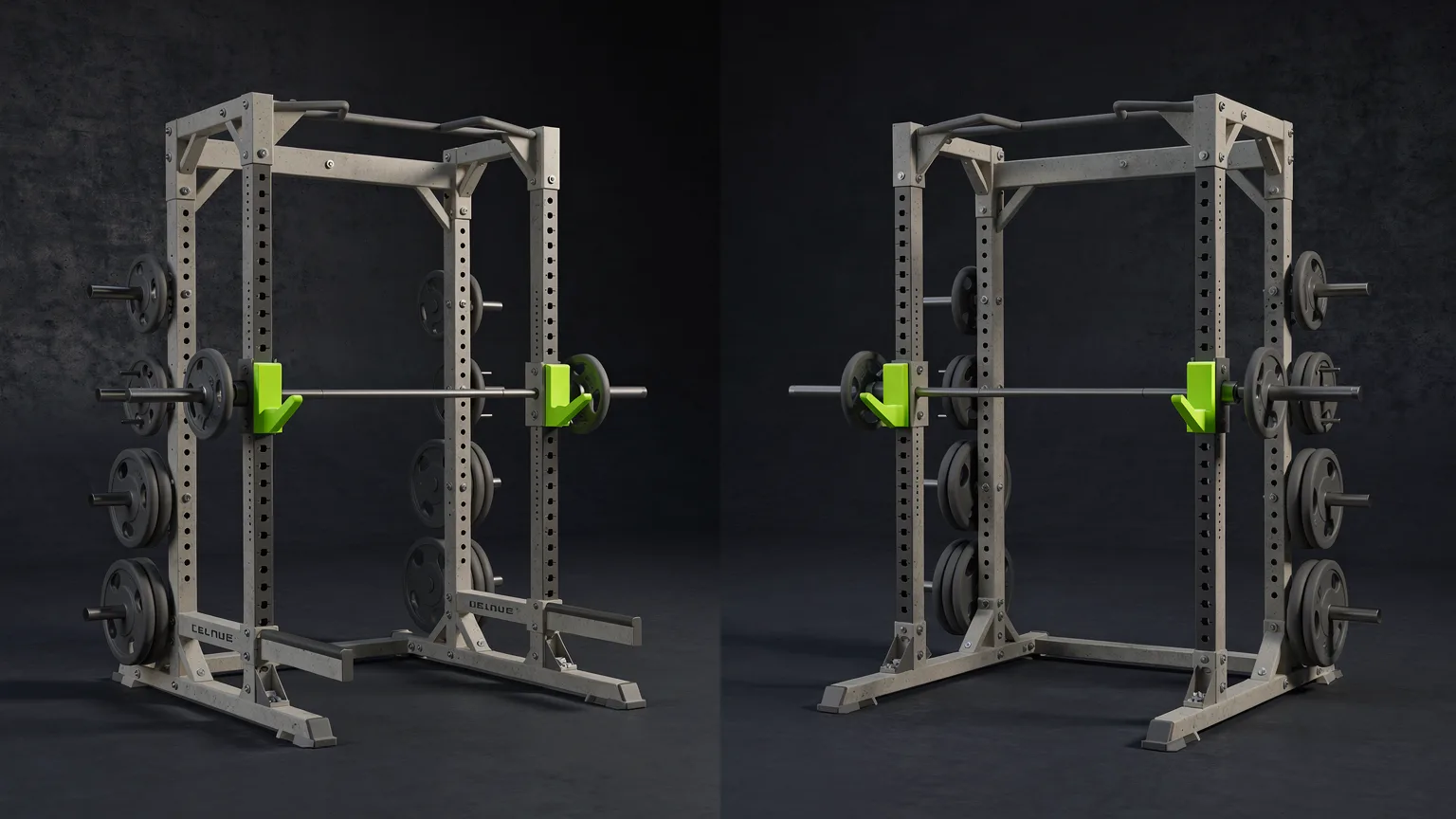
Power rack vs half rack comes down to layout: a power rack (full rack) surrounds the bar with four uprights, while a half rack has two uprights and the lifter stands in front. From maker specifications the practical differences are floor area, height and which attachments are included. No maker states that either layout is safer.
The Body-Solid SPR1000 and the GYM MASTER cage below are cage-style racks; the BodyPower TITAN is a half rack. This page compares what is published and points to qualified professionals for questions about lifting safely. The site does not test racks.
What the manufacturers say each design is
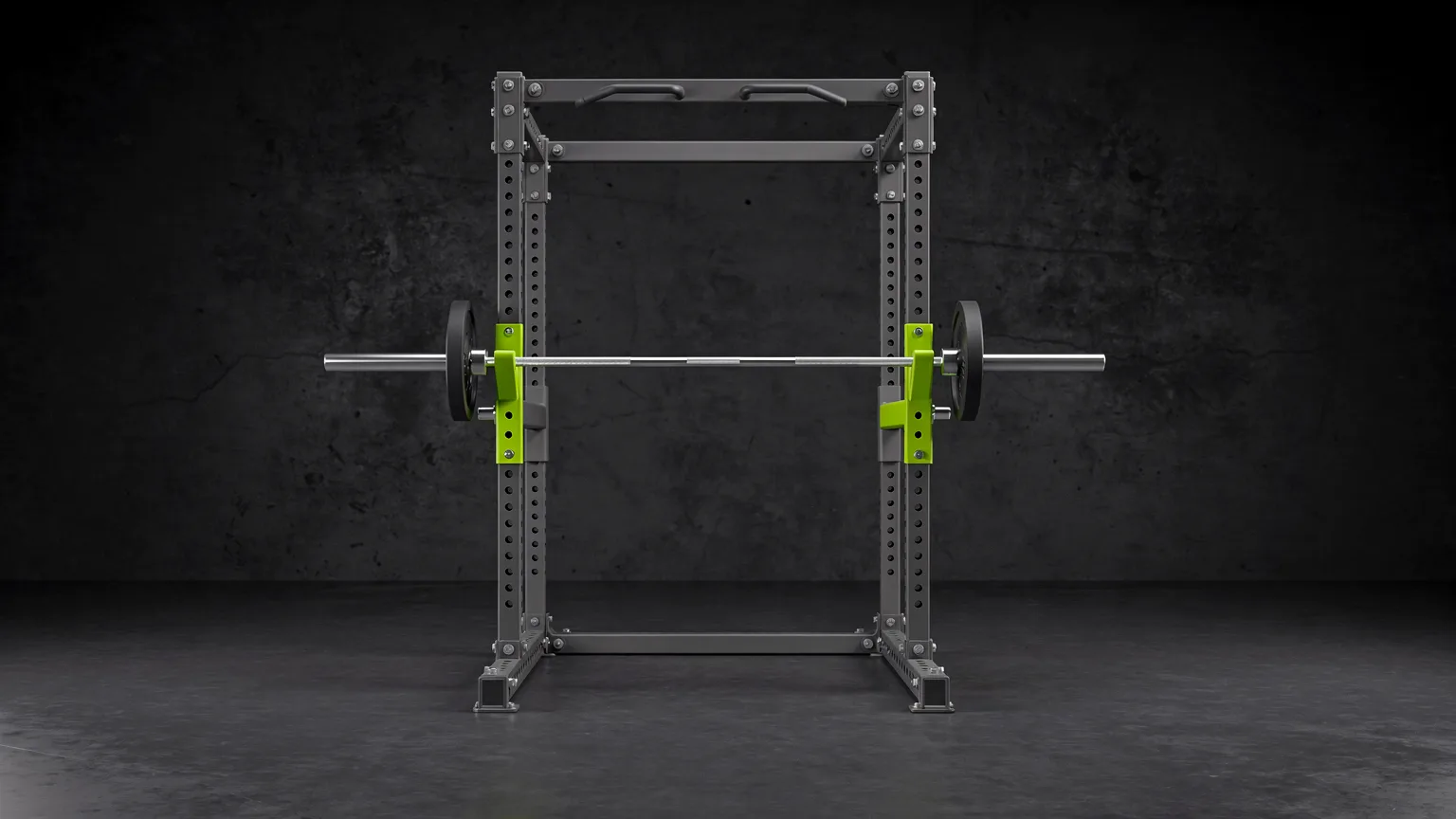
Body-Solid's owner's manual lists four uprights, two base frames and top frames for its SPR1000 rack (the manual is headed SPRCAGE), and the data sheet lists two J-cup liftoffs and two premium safety spotter bars. GYM MASTER describes its model as an adjustable squat rack cage with spotters and a pull-up bar, with one plate storage pole and one anchor point on each corner. BodyPower describes the TITAN as a half rack and says it can be converted to a full rack with an extra set of uprights and an upgrade kit, both sold separately.
Side-by-side from published figures
| GYM MASTER cage | Body-Solid SPR1000 | BodyPower TITAN half rack | |
|---|---|---|---|
| Layout | Cage with a plate pole and anchor point at each corner | Full power rack, four uprights | Half rack, two-post |
| Listed size | 121.5 x 121.5 x 220.5cm | About 2057 x 1340 x 2267mm | 157.6 x 175.8 x 216cm with lat tower |
| Listed capacity | 200kg J-cups and spotters | 1000lb (about 454kg) overall | 400kg J-hooks and safety booms |
| Frame | 50 x 50mm tube | 3 x 3 inch, 11-gauge steel | 75 x 75 x 3mm steel |
| Hole spacing | 5cm, 28 positions from 45cm to 197.5cm | 1 inch on safeties and front bench-press holes; 3 inch on upright side holes | Not published (laser-cut numbers at every hole) |
| Warranty | Not published | Lifetime on frame and welds (data sheet) | Lifetime on frame excluding paint; 3 years components; 1 year pads and grips |
| Indicative price (checked Oct 2026) | Around £100 | Around £1,097 | Around £1,259 |
The three racks differ in price class, so the table shows the range of what is sold rather than a like-for-like contest. The Body-Solid data sheet gives an 81 x 53 x 89 inch size and the product page gives 90 inch in its description; the figures above use the page's millimetre table.
Is a half rack safer than a power rack?
No maker page used for this guide states that either layout is safer. A full rack has four uprights and a half rack has two, so the difference is in structure and footprint, not a published safety rating. Each maker's manual or product page is the authority on how its safeties and J-cups are meant to be used. For advice on lifting safely, speak to a qualified coach or fitness professional.
Which takes up less floor space, a power rack or a half rack?
It depends on the model: of the racks compared, the GYM MASTER cage has the smallest listed footprint at 121.5 x 121.5cm, while the BodyPower TITAN half rack is listed at 157.6 x 175.8cm with its lat tower attached. The SPR1000 is roughly 2.06m long and 1.34m wide. The maker of the TITAN does not list a footprint without the lat tower on the page, so a half rack is not automatically the smaller option. For layouts in cramped rooms see small apartment home gym setup, and for garages garage gym essentials.
How tall are these racks?
The listed heights are 220.5cm for the GYM MASTER, about 227cm for the Body-Solid SPR1000 (2267mm in the maker's table) and 216cm for the BodyPower TITAN, so all three stand between 2.16m and 2.27m. Height matters as much as floor area. Measure the ceiling, allowing for any pull-up movement, and measure the doors and stairs the parts must pass through. The TITAN is listed at 158.3kg, and BodyPower says its Premium Installation service for items over 85kg is ground floor only. Body-Solid's description says its 90 inch height suits chin-ups and standing shoulder presses that shorter racks may limit, which is the maker's claim rather than a measured one.
Safeties and stated capacities
Capacity statements are not published in the same way. BodyPower lists separate figures for each part: 400kg for J-hooks, safety booms and monolifts, 250kg for the pull-up bar and dipping horns, 160kg for the lat tower and 65kg for the weight storage post. GYM MASTER lists 200kg for J-cups and spotters and 120kg for the pull-up bar, with no total. Body-Solid's data sheet gives a single 1000lb weight capacity. When comparing, check what each number refers to, and keep in mind the load on the bar includes the bar itself. The maker's manual, not a guide, is the authority on how to set up and use safeties.
BSI's listing for BS EN ISO 20957-4 says its scope covers strength training benches and free-standing barbell racks. This guide did not find a statement on the three maker pages that a given rack meets it, so ask the seller if that matters to you.
What does each layout mean for the room?
This section is reasoning from the layouts, not a claim about use. A frame with uprights on all sides takes up floor on all sides, and the bar sits inside it, so the room needed around the rack is set by how the frame and any bench are placed. A two-post frame leaves the back open, which changes where weights and a bench can sit relative to the walls. Body-Solid's manual advises placing its rack a few feet from walls or furniture for easy access, and on a solid, level surface. Heavier racks also load the floor in a smaller area, and whether a floor can take that is a question for the floor's owner or a qualified professional. See flooring for heavy weights for surface options.
Can a half rack be turned into a full rack?
BodyPower says the TITAN half rack can be converted to a full rack with an extra set of uprights and an upgrade kit, both sold separately, and the page lists no price for either. Other half racks may not offer this, so check the maker's page. Body-Solid takes a different route to growth: its page lists connector bars and monkey bars to bolt two or more SPR1000 racks together, and a rear extension for weight storage and rear spotter access. Both are optional extras, so the total cost rises with each add-on.
Do power racks need to be bolted to the floor?
All three makers recommend or advise it. Body-Solid's manual says to securely anchor its rack to the floor using the anchor holes and to consult a professional contractor. GYM MASTER strongly recommends bolting its rack to the ground and supplies anchoring bolts, one for each corner. BodyPower advises bolting down where possible and says its optional jammer arms must be used with loaded weight storage horns or the lat tower to counterbalance, otherwise the frame can tip. Body-Solid's page likewise says its jammer arms require the rack to be bolted to the floor. A half rack is not exempt, and a full rack does not remove the need to read the anchoring advice.
Attachments and expansion
Body-Solid lists more than 15 optional attachments for the SPR1000, including dip handles, a monolift and a rear extension. The TITAN ships with a lat tower, landmine, monolifts and dipping horns on the maker's list, and can be extended to a full rack. GYM MASTER includes plate storage poles and a pull-up bar. Add-ons and an upgrade path raise the total cost beyond the indicative prices above.
Which to choose, reasoned from the specification
- Tightest floor area and budget: the GYM MASTER, with its 121.5cm square base and around £100 price.
- Room for a long frame, and a commercial specification wanted: the Body-Solid full rack.
- A two-post layout with pulley-style and landmine work built in, and possible later conversion: the BodyPower half rack.
Detail is in the reviews of the GYM MASTER rack, the Body-Solid SPR1000 and the BodyPower TITAN, and the wider ranking is in best power rack for a home gym. The guide to choosing a power rack covers the other criteria.
Who should skip both
If the ceiling is below the listed heights or the floor cannot take fixings, neither layout is straightforward. Check anchoring advice before buying, and read home gym equipment for renters if drilling is not allowed.