Home gym storage works best when it is built into what you buy: choose equipment that folds, stacks, adjusts or comes apart, and decide where each item rests before it arrives. Keep exits clear, keep heavy items low, and check with a landlord or the maker before fixing anything.
What is the best way to store home gym equipment in a small home?
Choose items that fold, stack or adjust, check the maker's published dimensions, and decide where each item rests before buying. Storage is easier to solve at the purchase stage than afterwards. For each item, find the published dimensions and the folded or stowed size where the maker gives one; where only the in-use size is published, ask the seller.
Then decide how you will move the item between storage and use. If the answer is "I will have to lift it over other things," it is likely to be awkward to live with. The NHS recommends muscle-strengthening activity on at least 2 days a week, and the page also recommends aiming for activity on 4 to 5 days a week or every day. Kit that takes a few minutes to set out is easier to use that often than kit that needs rearranging a room, which is reasoning rather than a sourced finding.
Which equipment stores itself?
- Adjustable weights. One adjustable set replaces several fixed pairs, so there is less to store. See the adjustable vs fixed dumbbells guide and adjustable dumbbells guide. Check the maker's stated dimensions for the stand or tray as well as the weights.
- Bands. They pack into a bag or drawer; see the resistance bands guide.
- Stowable and folding benches. Check the folded size and whether folding needs tools. See the folding bench guide and the Bowflex 5.1S Stowable Bench review.
- Folding cardio equipment. Some treadmills fold; the folding treadmill guide compares them using maker dimensions.
- Racks with built-in plate storage. Gym Master's squat rack cage lists plate storage poles on each corner with adapters for standard and Olympic plates, at 121.5cm wide and deep and 220.5cm high, so plates live on the frame rather than the floor.
Where should I keep things?
| Place | Suits | Check first |
|---|---|---|
| Under a bed or sofa | Mats, bands, tiles | Clearance height against the item's published thickness or folded height |
| Cupboard or wardrobe | Dumbbells, kettlebells, a folded bench | Keep heavy items low so you lift as little as possible |
| Behind a door or against a wall | Folded benches, leaning mats | That the door still opens fully and the route out is clear |
| Rack or shelf for weights | Plates, dumbbells | The maker's instructions for the rack or stand; heavy loads stay low and stable |
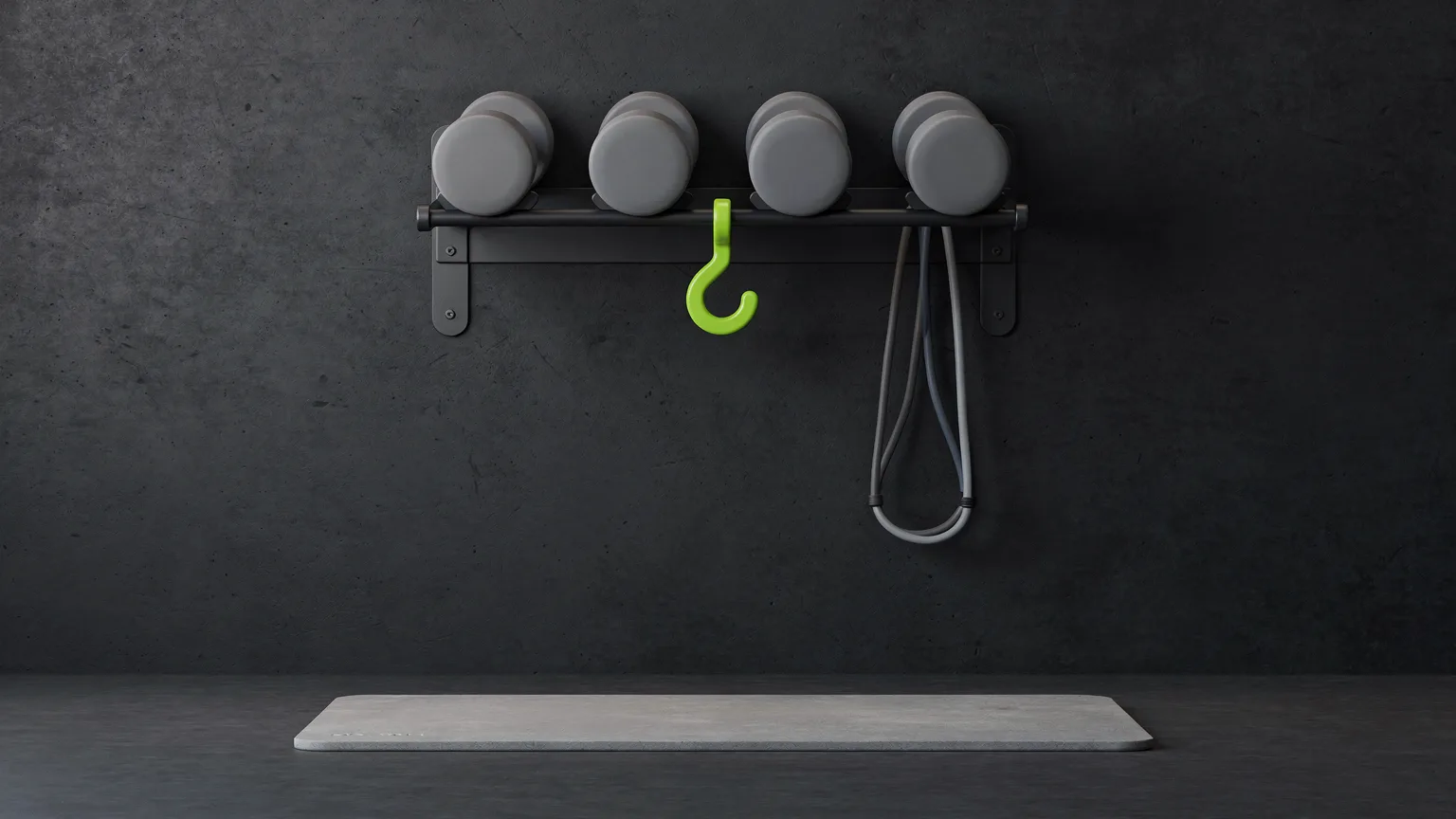
| Wall mounts and hooks | Bands, bars | The item's stated limits and your tenancy; fixings may need written permission |
| Hallway, stairs, landing | Nothing | GOV.UK says to keep exits clear |
Is it safe to store equipment in a hallway?
Avoid it. GOV.UK's fire safety guidance says to make sure exits are kept clear, to check there is nothing in corridors or stairways that could catch fire, and to think of a second escape route in case the first is blocked. Do not store gym kit in hallways, on stairs or in front of the door you would use to leave the home. The same page says to fit at least one smoke alarm on every level of the home, so check alarm cover if you convert a spare room or garage.
How do I store heavy weights safely?
Keep them low and stable, follow any maker instructions for stands or racks, and avoid lifting or carrying them further than necessary. HSE says manual handling means transporting or supporting a load by hand or bodily force, including lifting, putting down, pushing, pulling, carrying or moving loads, and that the law sets no specific weight limits though weight is important. Its first step is to avoid hazardous handling so far as reasonably practicable, so put the heaviest items where you can reach them without lifting above waist height or carrying them far, and ask for help with awkward items.
How do I keep the training area clear?
Loose plates, bands and bags are trip hazards, so return items after each session. The safety guide sets out what to check in the training area.
Can I mount gym storage on the wall in a rented flat?
Only if your tenancy allows it. GOV.UK says tenants must repair or pay for any damage caused by themselves, their family or friends, and the private renting page does not mention alterations, so the agreement decides. Ask your landlord in writing before drilling or fixing anything. The renters guide covers the questions to ask.
Floors under stored equipment
Heavy items left in one place can mark a floor. Mats or tiles can help, and the flooring guide, rubber vs foam comparison and York Fitness rubber mats review explain the options. Follow the flooring maker's instructions on what the product is designed to support, and check what is said about leaving it under static loads.
Layout ideas by space
- Studio flat or one-bed. Pick items that store out of sight, and train in a space that can be cleared. See the small apartment setup guide.
- Spare room. A fixed training area is possible; keep exits and windows accessible.
- Garage. More space, but think about damp, temperature, vehicles and ventilation; see the garage guide and ventilation and noise guide.
A simple storage audit
Before ordering, walk through these steps. They are a planning aid based on common sense, not a sourced method.
- List each item you own or plan to buy, and note its maker-stated dimensions.
- Mark where each will rest and the route from there to the training spot.
- Check that no route crosses an exit, stairway or the door you would use to leave.
- Decide which item is heaviest and make sure it rests low and needs the least carrying.
- Remove any item you cannot place. If it has no home, it is likely to end up on the floor.
What equipment takes the least storage space?
Resistance bands and adjustable weights generally take less room than separate fixed pairs, but check the maker's stated dimensions for any item before buying. Questions to ask a seller:
- What are the folded or stored dimensions, and the packaged size for delivery?
- Does it need tools to fold or stow, and does the maker say how often it should be done?
- What does the maker say about leaving it folded, leaning or stacked?
- What are the return terms if the item turns out not to fit? GOV.UK says online customers can cancel up to 14 days after delivery without giving a reason, with exceptions such as goods worth £42 or less, but a retailer's own policy covers collection of bulky items.
Who should rethink the purchase?
If you cannot find a place to store a large item without blocking exits or lifting it awkwardly, choose something smaller. For a starting list, see the beginner's guide and the strength training checklist.